Retatrutide: what it does, side effects, and trial results
Evidence reviewed: November 15, 2026.
Retatrutide is investigational, is not FDA-approved, and has not been found safe and effective for any condition. It cannot be compounded under federal law. This page is not medical advice. FDA
The published trials report weight loss and improvements in some other measured outcomes. That evidence does not establish safe use outside trials or make products sold online reliable.
TL;DR
- Retatrutide is investigational, is not FDA-approved, and has not been found safe and effective for any condition. It cannot be compounded under federal law.
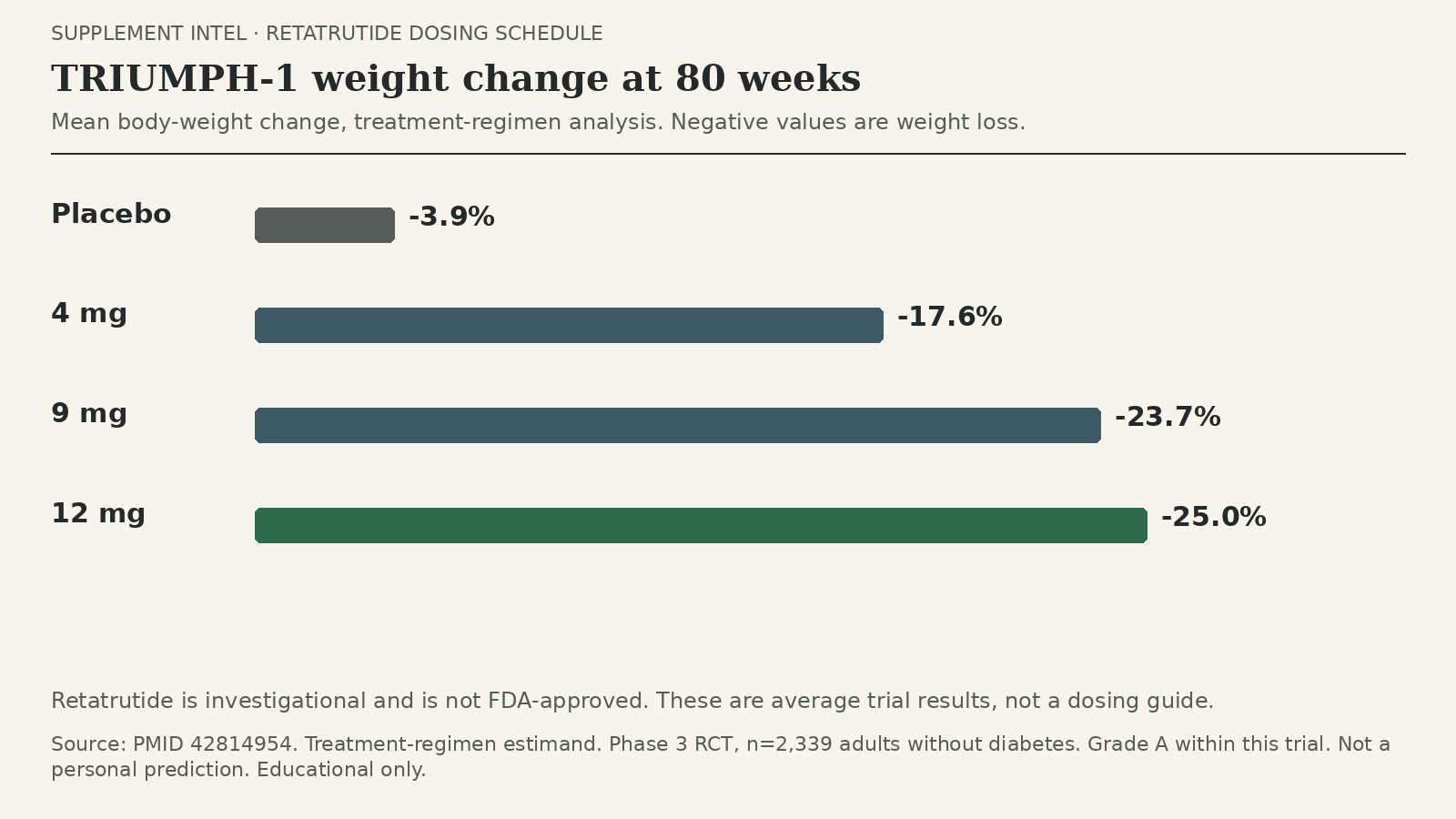
- In TRIUMPH-1, adults without diabetes assigned to 4, 9, or 12 mg had mean weight changes of −17.6%, −23.7%, and −25.0%, versus −3.9% with placebo at 80 weeks, using the treatment-regimen analysis. Weight loss versus placebo is Grade A because several randomized trials agree; these averages are not predictions for an individual.
- Retatrutide side effects: stomach and bowel problems were the most common. In TRIUMPH-2, nausea affected 14% to 28% of the retatrutide groups versus 8% with placebo. TRIUMPH-2 also reported low blood pressure (hypotension) and dysesthesia, an altered skin sensation. Phase 2 reported heart-rate increases. Full side-effect data.
- No published head-to-head trial of retatrutide versus tirzepatide was identified as of November 15, 2026. Figures from separate trials do not establish that one drug is superior. See tirzepatide vs retatrutide.
- Trial dosing protocols are summarized on the retatrutide dosing schedule page. They describe research, not instructions.
- FDA has warned about illegal online sales of unapproved retatrutide, including products falsely labeled for research use.
Get one email a week grading 3–5 health claims A, B or C from the actual studies. Free, no hype. Subscribe →
Frequently asked questions
Is retatrutide FDA-approved?
No. As of November 10, 2026, retatrutide is not an FDA-approved drug, and the U.S. Food and Drug Administration states that retatrutide and cagrilintide “cannot be used in compounding under federal law” and “have not been found safe and effective for any condition” (https://www.fda.gov/drugs/drug-alerts-and-statements/fdas-concerns-unapproved-glp-1-drugs-used-weight-loss).
How do retatrutide and tirzepatide compare in trials?
No head-to-head trial has been published. In separate trials, TRIUMPH-1 reported mean weight changes of −17.6%, −23.7%, and −25.0% with retatrutide 4, 9, and 12 mg at 80 weeks (placebo −3.9%), and SURMOUNT-1 reported −15.0%, −19.5%, and −20.9% with tirzepatide 5, 10, and 15 mg at 72 weeks (placebo −3.1%). Separate trials cannot show which drug is better. Details: tirzepatide vs retatrutide. [PMIDs 42814954, 35658024]
What retatrutide doses did the clinical trials use?
The Phase 2 obesity trial studied weekly maintenance doses of 1, 4, 8, and 12 mg. The Phase 2 diabetes trial studied 0.5, 4, 8, and 12 mg. TRIUMPH-1 and TRIUMPH-2 studied 4, 9, and 12 mg; TRIUMPH-3 and TRIUMPH-4 studied 9 and 12 mg. These are trial assignments, not instructions for use. Details: retatrutide dosing schedule in trials. [PMIDs 37366315, 37385280, 41090431]
How much weight loss did retatrutide show in trials?
In TRIUMPH-1, adults without diabetes assigned to 4, 9, or 12 mg had mean weight changes of −17.6%, −23.7%, and −25.0%, versus −3.9% with placebo at 80 weeks, using the treatment-regimen analysis. Weight loss versus placebo is Grade A because several randomized trials agree; these averages are not predictions for an individual. [PMID 42814954]
What side effects were reported with retatrutide?
Gastrointestinal problems were the most common adverse events. In TRIUMPH-2, diarrhea affected 27% to 34% and nausea 14% to 28% of the retatrutide groups, versus 13% and 8% with placebo. TRIUMPH-2 also reported hypotension and dysesthesia, or altered skin sensation. Phase 2 reported heart-rate increases. The dedicated knee osteoarthritis paper reported more serious adverse events with retatrutide than placebo in both trials it analyzed. [PMIDs 37366315, 42810372, 43001755]
What is dysesthesia on retatrutide?
Dysesthesia is an unusual or unpleasant skin sensation, such as tingling or burning. It was reported in 4% to 7% of the retatrutide groups in TRIUMPH-2 versus 1% with placebo. Lilly’s TRIUMPH-1 release reported 5.1% to 12.5% versus 0.9%, and said most events were mild to moderate and most resolved during treatment. The cause is not established. [PMID 42810372; Lilly release]
How many people stopped retatrutide because of side effects?
In TRIUMPH-2, permanent discontinuation because of adverse events or death was 4%, 12%, and 8% with 4, 9, and 12 mg, versus 5% with placebo (Grade B, one trial). Lilly reported 4.1%, 6.9%, and 11.3% versus 4.9% in TRIUMPH-1 (Grade B, company release). [PMID 42810372; Lilly release]
Can retatrutide be compounded or bought online?
Retatrutide cannot be compounded under federal law. FDA has warned about illegal sales of unapproved products containing retatrutide, including products falsely labeled for research purposes or not for human consumption. Those labels do not establish safety or quality. [FDA; reference 9]
How should I read the retatrutide evidence?
Our evidence posture is cautious: distinguish published results from study plans, and keep each finding tied to the people and outcomes actually studied.
- Grade A: consistent randomized human evidence for that exact outcome (more than one randomized trial agreeing, or a pooled analysis of consistent trials).
- Grade B: human evidence that is limited, mixed, short, small, from a single trial, or surrogate-only (for example, a lab or imaging measure instead of how people feel or function).
- Grade C: animal, lab, cell, mechanistic, uncontrolled, anecdotal or expert-opinion evidence, comparisons between separate trials, or no human evidence.
Under this key, an outcome that rests on one randomized trial, even a large Phase 3 trial, is Grade B, and so is an outcome measured only by a surrogate. Knee osteoarthritis pain described below is Grade A because two randomized trials agree. Sleep apnea breathing events are Grade B because the apnea–hypopnea index is a measured breathing count, not how people feel or function. No grade extends to other populations or to comparisons with another drug.
What is retatrutide?
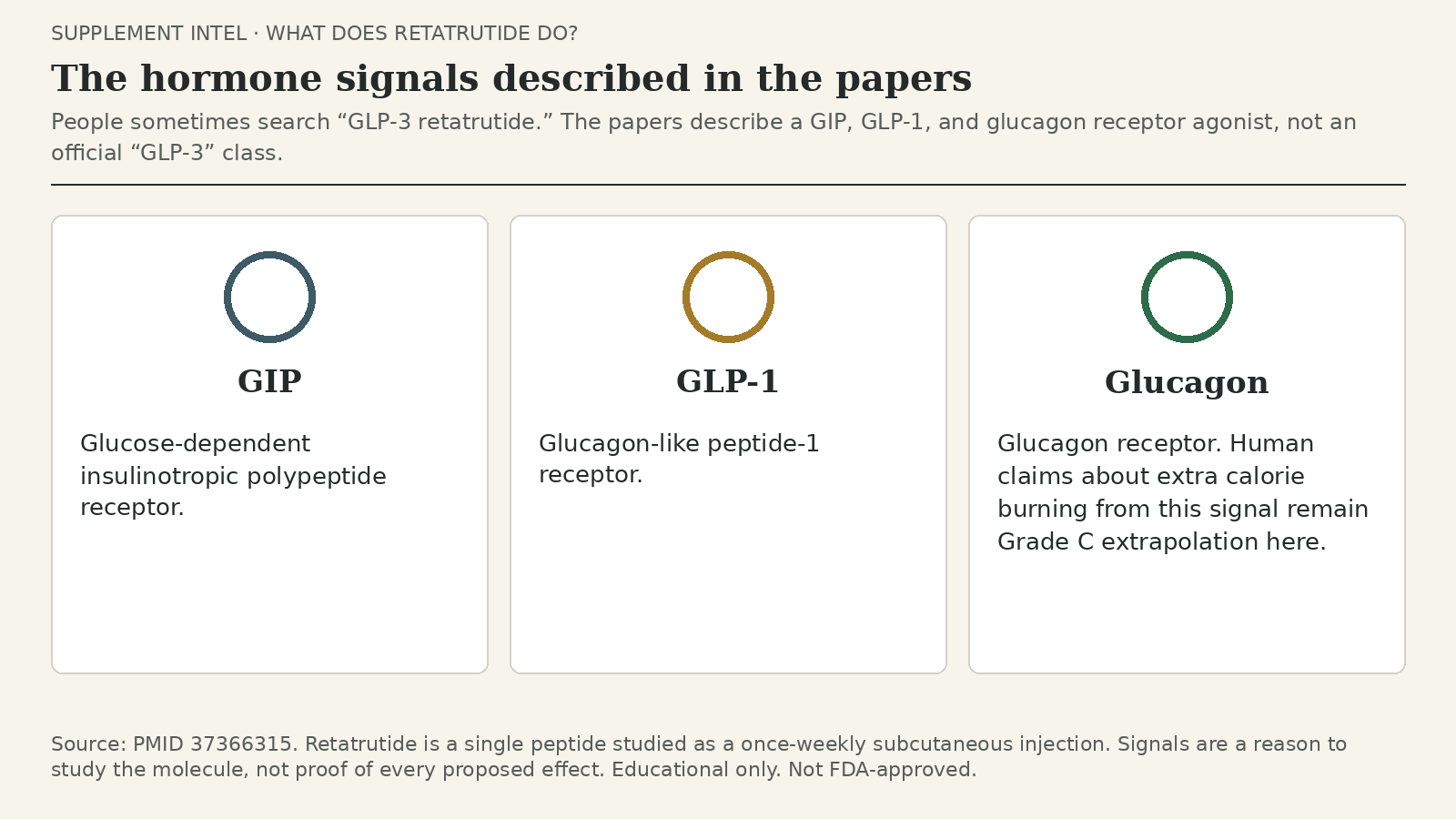
Retatrutide, also called LY3437943, is a single peptide studied as a weekly injection under the skin. It activates three receptors: GIP, GLP-1, and glucagon. Tirzepatide activates GIP and GLP-1 receptors. This is established pharmacology described in published trial reports, not a claim that the extra receptor makes retatrutide better. [PMIDs 37366315, 35658024]
What does the evidence say retatrutide does?
- A: TRIUMPH-1 and TRIUMPH-2 reported greater average weight loss with retatrutide than placebo in adults without and with type 2 diabetes, respectively. [PMIDs 42814954, 42810372]
- A: two randomized Phase 3 trials, reported in one paper, found improvements in knee osteoarthritis pain in the groups studied. [PMID 43001755]
- B: published Phase 3 studies reported fewer sleep apnea breathing events, a measured index (surrogate) rather than how people feel. [PMID 42904878]
- B: earlier Phase 2 studies reported weight loss and, in type 2 diabetes, lower HbA1c, a measure of blood sugar over time. [PMIDs 37366315, 37385280]
- C: a claim that retatrutide is better than tirzepatide is not established by these separate trials. TRIUMPH-5 has no published results. [NCT06662383]
What retatrutide doses did the trials use?
These are descriptions of research protocols, not instructions for taking retatrutide. Phase 2 trials assigned weekly maintenance doses of 1, 4, 8, or 12 mg (obesity) and 0.5, 4, 8, or 12 mg (type 2 diabetes). TRIUMPH-1 and TRIUMPH-2 assigned 4, 9, or 12 mg; TRIUMPH-3 and TRIUMPH-4 assigned 9 or 12 mg. Lilly reports that TRIUMPH-1 participants started at 2 mg once weekly and stepped up every four weeks to their assigned dose. Grade B for design papers and company protocol descriptions. [PMIDs 37366315, 37385280, 41090431; Lilly release]
The full trial-by-trial breakdown, the TRIUMPH-1 escalation steps, and what the trials did when people had side effects are on the retatrutide dosing schedule page.
What did Phase 2 retatrutide trials find?
In the obesity trial, the main outcome was the least-squares mean percent change in body weight at 24 weeks. Reported values were −7.2% with 1 mg, −12.9% with combined 4 mg, −17.3% with combined 8 mg, and −17.5% with 12 mg, versus −1.6% with placebo. At 48 weeks:
| Group | Weight change |
|---|---|
| 1 mg | −8.7% |
| Combined 4 mg | −17.1% |
| Combined 8 mg | −22.8% |
| 12 mg | −24.2% |
| Placebo | −2.1% |
The combined groups pool different starting doses. At 48 weeks, a weight reduction of 5% or more, 10% or more, and 15% or more was reported in 92%, 75%, and 60% of participants who received 4 mg; 100%, 91%, and 75% of those who received 8 mg; 100%, 93%, and 83% of those who received 12 mg; and 27%, 9%, and 2% of those who received placebo. Grade B. [PMID 37366315]
In the diabetes trial, the main outcome was the change in HbA1c at 24 weeks. Least-squares mean changes were:
| Group | HbA1c change at 24 weeks | Weight decrease at 36 weeks |
|---|---|---|
| Retatrutide 0.5 mg | −0.43% | 3.19% |
| 4 mg (started at 2 mg) | −1.39% | 7.92% |
| 4 mg (no escalation) | −1.30% | 10.37% |
| 8 mg slow (started at 2 mg) | −1.99% | 16.81% |
| 8 mg fast (started at 4 mg) | −1.88% | 16.34% |
| 12 mg (started at 2 mg) | −2.02% | 16.94% |
| Placebo | −0.01% | 3.00% |
| Dulaglutide 1.5 mg | −1.41% | 2.02% |
HbA1c reductions were greater than placebo in all but the 0.5 mg group (p<0.0001). They were greater than dulaglutide in the 8 mg slow group (p=0.0019) and the 12 mg group (p=0.0002). The paper says findings were consistent at 36 weeks but does not give additional week-36 HbA1c numbers in the abstract used here. For doses of 4 mg and higher, weight decreases at 36 weeks were greater than placebo and greater than dulaglutide. These are findings from that Phase 2 trial, not TRIUMPH-2. Grade B. [PMID 37385280]
What did Phase 3 retatrutide trials find?
Weight: TRIUMPH-1 and TRIUMPH-2
The following are treatment-regimen results at 80 weeks, keeping the analysis tied to randomized assignment rather than presenting only treatment-adherent results.
| Assigned group | TRIUMPH-1: without diabetes | TRIUMPH-2: with type 2 diabetes |
|---|---|---|
| 4 mg | −17.6% | −11.9% |
| 9 mg | −23.7% | −16.8% |
| 12 mg | −25.0% | −18.8% |
| Placebo | −3.9% | −5.1% |
TRIUMPH-1 randomized 2339 participants. Differences versus placebo for the 9 mg and 12 mg groups, the primary dose comparisons, were −19.8 and −21.0 percentage points (P<0.001 for both). TRIUMPH-2 randomized 1152 participants; 965 (84%) completed the study drug. Estimated treatment differences versus placebo were −6.9% (95% CI −8.7 to −5.1) with 4 mg, −11.8% (−13.7 to −9.8) with 9 mg, and −13.8% (−15.8 to −11.8) with 12 mg (p<0.0001 for all). Grade A for weight loss versus placebo, because both trials, and the Phase 2 trials, agree. The columns describe different studies and populations. The TRIUMPH-2 abstract describes improved blood sugar control but does not give numeric HbA1c changes. [PMIDs 42814954, 42810372]
Knee osteoarthritis pain
TRIUMPH-4 enrolled 445 participants and measured pain at 68 weeks. In the dedicated paper, the WOMAC pain scale runs from 0 to 10, with higher scores meaning worse pain. Under the paper’s hybrid-treatment analysis, changes were −3.96 with 9 mg and −3.74 with 12 mg, versus −2.12 with placebo. Differences from placebo were −1.83 and −1.61 points. The intention-to-treat (ITT) differences were −1.70 and −1.38 points.
Weight changes using the treatment-policy analysis were −20.0%, −23.7%, and −4.6%, respectively. The same paper also reports TRIUMPH-1’s knee osteoarthritis group (574 participants) at 80 weeks. It describes the WOMAC pain scale as 0 to 10; the main TRIUMPH-1 paper describes the scale as 1 to 10. Those source descriptions should not be silently treated as identical. In the dedicated paper, hybrid-treatment changes in that TRIUMPH-1 group were −3.22, −3.48, and −3.64 with 4, 9, and 12 mg, versus −1.87 with placebo. Grade A for knee pain, because the two randomized trials (TRIUMPH-4 and the TRIUMPH-1 knee group) agree. [PMID 43001755]
Obstructive sleep apnea
The dedicated paper reports 243 participants without diabetes (TRIUMPH-1-OSA) and 448 with diabetes (TRIUMPH-2-OSA). It measured the apnea–hypopnea index (AHI): breathing interruptions per hour. Baseline mean AHI was 58.6 and 55.9 events per hour, respectively.
For the 9 and 12 mg groups without diabetes, hybrid-treatment differences from placebo at 80 weeks were −24.4 and −21.9 events per hour. ITT differences were −24.7 and −22.5. With diabetes, the corresponding hybrid differences were −14.4 and −15.1; ITT differences were −13.9 and −15.0. Both analyses are reported because they answer the outcome question using different rules. As a key secondary outcome, mean percent change in body weight (treatment-regimen analysis) was −12.5% to −22.2% in TRIUMPH-1-OSA and −12.1% to −18.5% in TRIUMPH-2-OSA, versus −4.8% and −5.6% with placebo; the abstract reports those as ranges across retatrutide doses, not as a dose-by-dose split. Grade B for breathing events: the AHI is a measured index (a surrogate), and the abstract reports no symptom outcomes. Weight loss versus placebo in these groups agrees with the other trials (Grade A). [PMID 42904878]
Trials with no peer-reviewed outcomes yet
TRIUMPH-3 is listed as completed on ClinicalTrials.gov. Lilly released top-line TRIUMPH-3 results in July 2026 as company data, not yet in a peer-reviewed journal; as of November 10, 2026, we found no peer-reviewed outcomes paper. This page does not report figures from that company release. [Lilly July 2026 release, company source] TRIUMPH-5, comparing retatrutide with tirzepatide, was active but not recruiting, with no posted results. Estimated completion dates are not publications. Grade C for claims depending on outcomes that have not been released. [NCT05882045; NCT06662383]
What are the side effects of retatrutide?
Across the published trials, the most common retatrutide side effects were stomach and bowel problems: nausea, diarrhea, constipation, and vomiting. They were more common at higher doses, and in Phase 2 they were mostly mild to moderate. Two less familiar effects also appeared more often than with placebo: dysesthesia, an altered skin sensation, and low blood pressure (hypotension). These are trial findings, not a full safety profile. Long-term safety outside trials is not established.
TRIUMPH-2: adults with obesity and type 2 diabetes
The table below uses the published TRIUMPH-2 abstract (80 weeks). More diarrhea and nausea than with placebo is Grade A, because other randomized retatrutide trials agree. The exact percentages, and the hypotension, dysesthesia and discontinuation rows, come from this one trial: Grade B.
| Adverse event | Placebo | 4 mg | 9 mg | 12 mg |
|---|---|---|---|---|
| Diarrhea | 13% | 27% | 34% | 34% |
| Nausea | 8% | 14% | 21% | 28% |
| Hypotension (low blood pressure) | <1% | 1% | 5% | 6% |
| Dysesthesia (altered skin sensation) | 1% | 4% | 6% | 7% |
| Stopped because of adverse events or death | 5% | 4% | 12% | 8% |
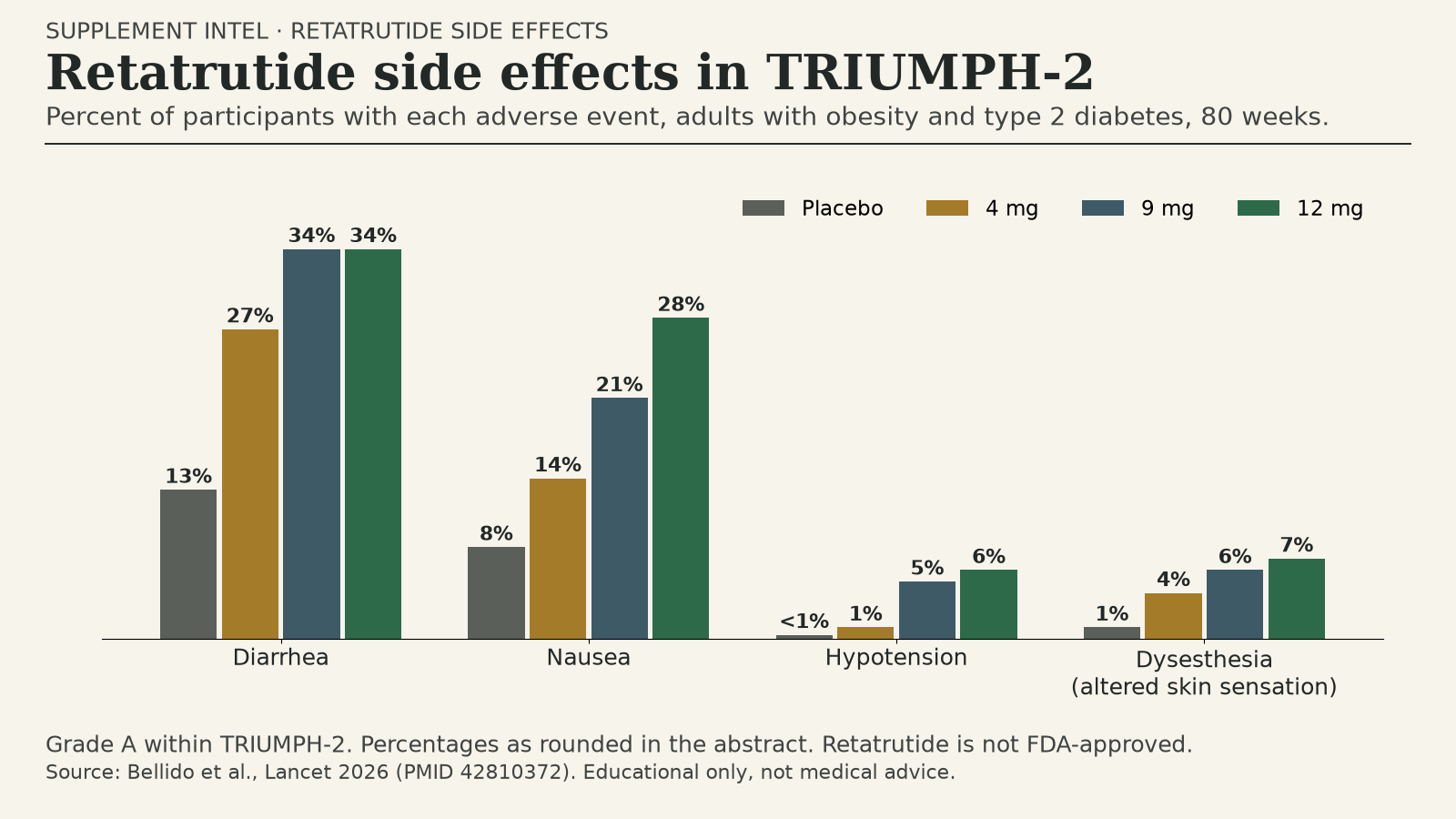
Counts behind those percentages: diarrhea 80/292, 95/284, and 96/286 in the 4, 9, and 12 mg groups versus 38/287 with placebo; nausea 40, 59, and 80 versus 23; hypotension 4, 14, and 18 versus 1; dysesthesia 13, 16, and 21 versus 2. Deaths occurred in 2, 3, and 1 participants in the retatrutide groups and 1 with placebo; investigators judged all of them unrelated to the study intervention. [PMID 42810372]
TRIUMPH-1: adults with obesity, without diabetes
The published TRIUMPH-1 abstract says gastrointestinal events were the most common but gives no percentages. Lilly’s May 21, 2026 release gives these figures. Grade B because they come from a company release, not the peer-reviewed abstract. [Lilly release; PMID 42814954]
| Adverse event | Placebo | 4 mg | 9 mg | 12 mg |
|---|---|---|---|---|
| Nausea | 14.8% | 28.6% | 38.4% | 42.4% |
| Diarrhea | 13.5% | 25.2% | 34.1% | 32.0% |
| Constipation | 10.9% | 23.8% | 25.9% | 26.1% |
| Vomiting | 4.8% | 10.6% | 22.8% | 25.3% |
| Dysesthesia | 0.9% | 5.1% | 12.3% | 12.5% |
| Urinary tract infection | 5.3% | 7.5% | 8.8% | 8.4% |
| Stopped because of adverse events | 4.9% | 4.1% | 6.9% | 11.3% |
Lilly said dysesthesia and urinary tract infections were generally mild to moderate, most resolved during treatment, and most participants kept taking retatrutide. [Lilly release]
What did Phase 2 show about side effects?
In Phase 2 obesity, stomach and bowel problems were the most common adverse events. They were dose-related, mostly mild to moderate, and partly reduced by a lower starting dose. Heart-rate increases peaked at 24 weeks and then declined; the abstract does not provide beats-per-minute figures. Grade B. [PMID 37366315]
Registry safety results for that trial (up to 52 weeks) show how much the starting dose mattered: nausea was reported in 6/35 (17.1%) of the 8 mg group that started at 2 mg, versus 21/35 (60.0%) of the 8 mg group that started at 4 mg, and 8/70 (11.4%) with placebo. These small-arm registry counts are Grade B. [NCT04881760]
In the Phase 2 diabetes trial, mild-to-moderate gastrointestinal adverse events were reported in 67 (35%) of 190 participants in the retatrutide groups, ranging from 6 (13%) of 47 at 0.5 mg to 12 (50%) of 24 in the 8 mg fast-escalation group, compared with 6 (13%) of 45 with placebo and 16 (35%) of 46 with dulaglutide 1.5 mg. There were no reports of severe hypoglycemia and no deaths. Grade B. [PMID 37385280]
Were serious side effects reported?
The dedicated knee osteoarthritis paper reported more serious adverse events with retatrutide than placebo in both trials it analyzed. Its abstract did not supply percentages. Trial findings do not establish long-term safety outside research. [PMID 43001755]
Products sold online as “research peptides” were not the products tested in these trials. Their contents and purity are unknown, so trial side-effect rates do not describe them. [FDA; reference 9]
How do retatrutide and tirzepatide compare in trials?
No published head-to-head trial was identified as of November 15, 2026. TRIUMPH-5, the trial designed to compare them, has not published results. In separate trials, TRIUMPH-1 reported −25.0% mean weight change with retatrutide 12 mg at 80 weeks, and SURMOUNT-1 reported −20.9% with tirzepatide 15 mg at 72 weeks. Those trials differed in length, doses, and participants, so a superiority claim is Grade C. [PMIDs 42814954, 35658024]
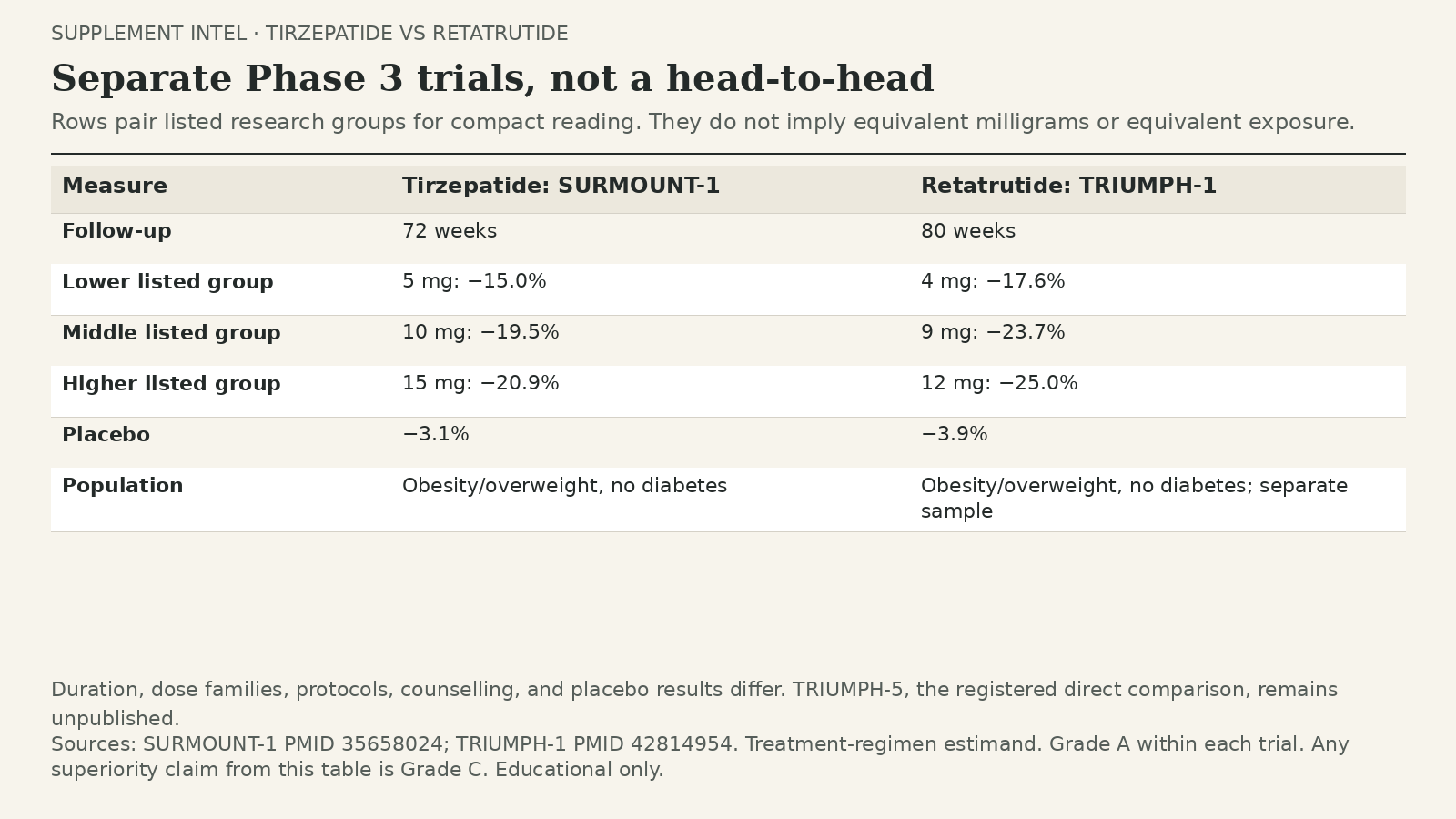
The full comparison, including the type 2 diabetes trials and side effects, is on tirzepatide vs retatrutide: what separate trials show.
What is still unknown about retatrutide?
Long-term safety outside trials, cardiovascular outcomes, and routine-care use are not established. The TRIUMPH-3 design included a planned DXA body-composition substudy of about 100 participants; this review has no results to report. It does not establish a lean-mass effect. [PMID 41090431]
Other gaps include TRIUMPH-3 results that are not yet in a journal, unpublished TRIUMPH-5 outcomes, and HbA1c numbers that the TRIUMPH-2 abstract does not give. The TRIUMPH-1 escalation steps come from a Lilly release, not yet from a peer-reviewed paper.
A Lilly Medical Information page, last reviewed August 4, 2026, states that Lilly plans to submit a Biologics License Application in the first quarter of 2027. That is a company plan, not an approval. The same page says retatrutide has not been approved by the FDA or any other regulatory authority, and that there is no guarantee of approval or of meeting any anticipated submission timeline. Grade B as a labeled company statement. [reference 11]
FDA has warned about illegal online sales of unapproved retatrutide, including products falsely labeled for research use. Their quality is unknown. Retatrutide cannot be compounded under federal law. [FDA; reference 9]
Related evidence on this site
- Berberine evidence
- Creatine monohydrate evidence
- Omega-3 evidence
- Magnesium evidence
- Peptide evidence guide: BPC-157, TB-500, retatrutide
- TB-500: what the human evidence shows
More GLP-1 guides
- Retatrutide dosing schedule: doses and titration used in trials
- Tirzepatide vs retatrutide: what separate trials show
- BPC-157 side effects: what human studies show
- Tirzepatide side effects: what trials and labels show
- Tirzepatide vs semaglutide: what head-to-head trials show
- Does GLP-1 use cause muscle loss?
- Oral GLP-1 pills: what the trials show
- Do GLP-1 supplements work? Patches, drops and boosters reviewed
- Do GLP-1 patches work? What is in them and what the evidence shows
- Semaglutide with B12: what the evidence shows
- Berberine vs Ozempic: what the trials show
- GLP-1 vitamins and supplements: what has evidence
- Stopping a GLP-1: what trials show
Also see how we handle references and about Supplement Intelligence.
Want the next one graded?
Every week we take a few claims you'll see online and check them against the research. Plain English, sources linked, not medical advice.
Get the free weekly emailWhat are the primary sources for this retatrutide review?
- Jastreboff AM et al. Triple-Hormone-Receptor Agonist Retatrutide for Obesity - A Phase 2 Trial. N Engl J Med. 2023;389(6):514–526. PMID 37366315. DOI: 10.1056/NEJMoa2301972. NCT04881760.
- Rosenstock J et al. Retatrutide, a GIP, GLP-1 and glucagon receptor agonist, for people with type 2 diabetes: a randomised, double-blind, placebo and active-controlled, parallel-group, phase 2 trial conducted in the USA. Lancet. 2023;402(10401):529–544. PMID 37385280. DOI: 10.1016/S0140-6736(23)01053-X. NCT04867785.
- Jastreboff AM et al. Retatrutide, a Triple Hormone Receptor Agonist, for Treatment of Obesity. N Engl J Med. 2026;395(18):1781–1793. PMID 42814954. DOI: 10.1056/NEJMoa2604169. NCT05929066.
- Bellido V et al. Retatrutide in adults with obesity and type 2 diabetes (TRIUMPH-2): a double-blind, parallel-group, randomised, placebo-controlled, phase 3 trial. Lancet. 2026;408(10563):1455–1472. PMID 42810372. DOI: 10.1016/S0140-6736(26)01861-1. NCT05929079.
- Giblin K et al. Retatrutide for the treatment of obesity, obstructive sleep apnea and knee osteoarthritis: Rationale and design of the TRIUMPH registrational clinical trials. Diabetes Obes Metab. 2026;28(1):83–93. PMID 41090431. DOI: 10.1111/dom.70209. PMC12673447.
- Schnitzer TJ et al. Retatrutide Once Weekly in Adults with Knee Osteoarthritis Pain and Obesity. N Engl J Med. Epub November 8, 2026; volume/pages not yet assigned. PMID 43001755. DOI: 10.1056/NEJMoa2610676.
- Grunstein RR et al. Retatrutide Once Weekly for Treatment of Obstructive Sleep Apnea. N Engl J Med. Epub October 21, 2026; volume/pages not yet assigned. PMID 42904878. DOI: 10.1056/NEJMoa2611477.
- Jastreboff AM et al. Tirzepatide Once Weekly for the Treatment of Obesity. N Engl J Med. 2022;387(3):205–216. PMID 35658024. DOI: 10.1056/NEJMoa2206038. NCT04184622.
- FDA. FDA’s Concerns with Unapproved GLP-1 Drugs Used for Weight Loss. Verified November 10, 2026.
- ClinicalTrials.gov. NCT04881760: Phase 2 obesity arm descriptions and posted results; NCT05882045: TRIUMPH-3; NCT06662383: TRIUMPH-5. Status reviewed November 10, 2026.
- Lilly Medical Information. Is retatrutide available in the consumer market?. Date of last review: August 4, 2026. Fetched November 10, 2026. Company statement, not an approval.
- Eli Lilly and Company. Lilly’s triple agonist, retatrutide, delivered powerful weight loss in pivotal Phase 3 obesity trial. May 21, 2026. Company release; Grade B. Fetched November 15, 2026.
- Eli Lilly and Company. Lilly’s triple agonist, retatrutide, successful in two additional Phase 3 obesity trials, delivering significant improvements in weight and A1C. July 23, 2026. Company source (press release announcing TRIUMPH-2 and TRIUMPH-3 top-line results), not peer reviewed. Fetched November 25, 2026.
The numbered reference list above provides the published papers, FDA source, and trial registry links. Weight and safety findings should be traced to their own trial; design papers and registry status do not substitute for outcome papers.
This page summarizes published trials. It is not medical advice, a recommendation to start or stop a medicine, or an instruction to use retatrutide. Trial evidence is not a recommendation to use a product. Retatrutide is not FDA-approved.