BPC-157 side effects and safety: what human studies show
Evidence reviewed: November 15, 2026. Updated November 20, 2026.
BPC-157 is not FDA-approved, and its side effects in people are largely unknown. The FDA says it lacks sufficient information to know whether compounded BPC-157 would cause harm in humans. It is not approved for human use, and it is banned in sport. This page is not medical advice. [FDA] [USADA]
No products are linked or recommended on this page.
TL;DR
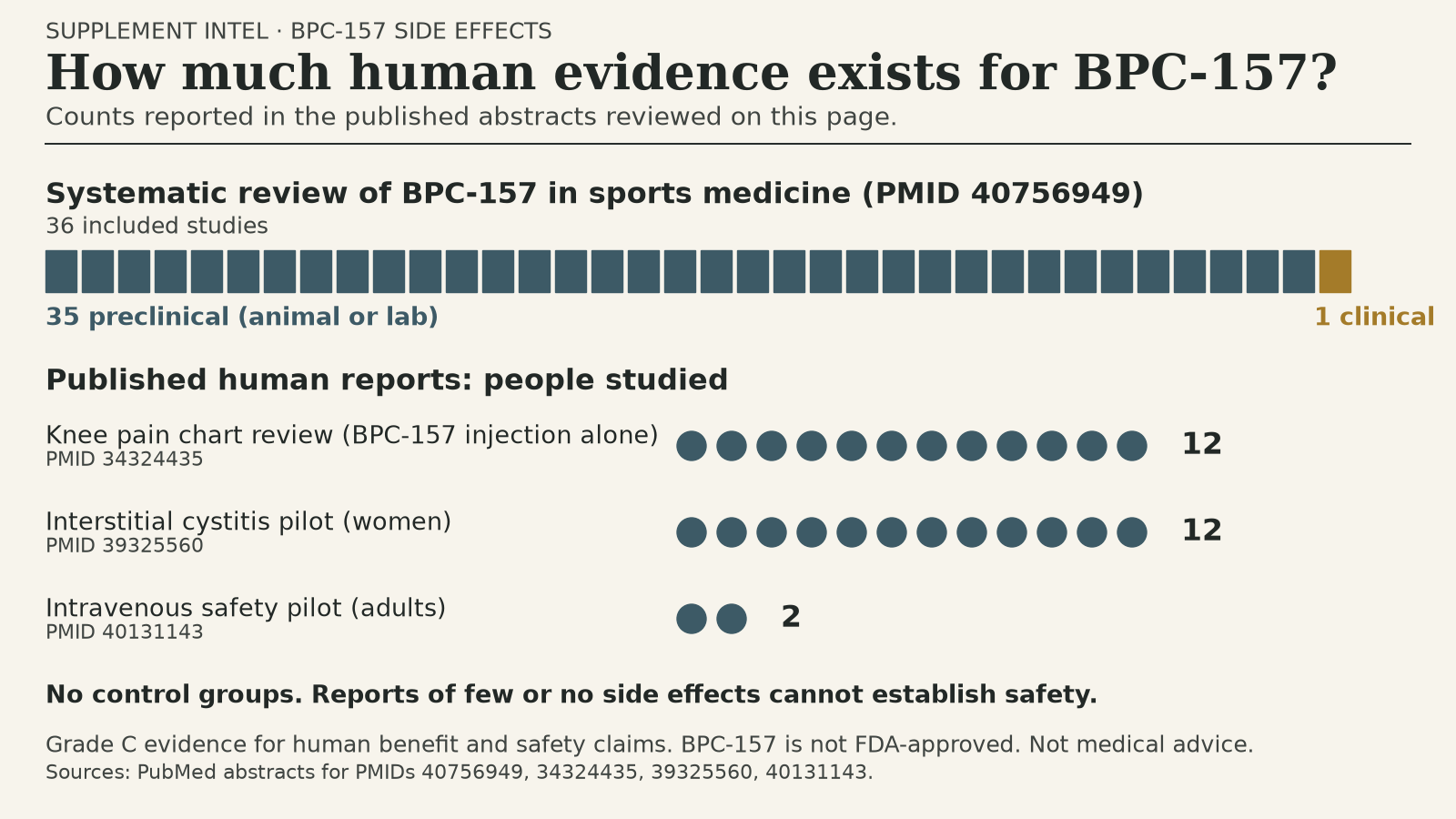
- There is no established human safety profile for BPC-157. We found only three small human reports, with 12, 12 and 2 participants, and none had a control group (Grade C). [PMIDs 34324435, 39325560, 40131143]
- Two of those reports said no side effects were reported; the third did not mention side effects in its abstract. Reports this small cannot rule out common, rare or long-term harms. [PMIDs 39325560, 40131143, 34324435]
- A 2025 systematic review of 36 studies (35 animal or laboratory, 1 clinical) found no clinical safety data. [PMID 40756949]
- The FDA flags possible immune reactions (immunogenicity) for some routes and problems with peptide impurities. [FDA]
- Athletes: BPC-157 is prohibited at all times under the World Anti-Doping Agency (WADA) list of non-approved substances. [USADA] [WADA S0 text]
- Reviews warn that gray-market products raise concerns about identity, purity, concentration and sterility (Grade C). [PMIDs 42937313, 40756949]
- BPC-157 vs TB-500: neither is FDA-approved, and the only direct comparison found was a rat study. [PMIDs 42542926, 42937313]
Get one email a week grading 3–5 health claims A, B or C from the actual studies. Free, no hype. Subscribe →
What side effects of BPC-157 have been reported in people?
Very few, mostly because very few people have been studied. Here is everything the published human reports say about side effects:
| Human report | People | How it was given (dose studied) | Side effects reported |
|---|---|---|---|
| Knee pain chart review, one Florida clinic [PMID 34324435] | 16 reached by phone; 12 had BPC-157 alone | Injection into the knee | The abstract does not report on side effects |
| Interstitial cystitis pilot [PMID 39325560] | 12 women | Injections around the bladder during cystoscopy (dose studied: 10 mg total, single procedure) | “No adverse events were reported” |
| Intravenous safety pilot [PMID 40131143] | 2 adults who had used IV BPC-157 before | IV infusion on two days (doses studied: 10 mg, then 20 mg) | No side effects reported; tested heart, liver, kidney, thyroid and glucose markers did not measurably change |
All three share the same lead author, were small, and had no comparison group. Grade C. A later review counted the same three pilot studies and concluded that no adverse effects were reported but rigorous, large-scale trials are lacking. [PMID 40789979]
Why can’t these studies show that BPC-157 is safe?
“No side effects reported” in 2 or 12 people is not the same as “safe.” A side effect that affects 1 in 100 users would usually be missed in a group that small. The studies were also short or retrospective. The knee review relied on phone calls months after injections, and the intravenous pilot followed two people for three days. [PMIDs 34324435, 40131143]
The 2025 systematic review put it plainly: no clinical safety data were found. Animal safety studies showed no adverse effects across several organ systems, but animal results do not establish human safety. The review added that adverse effects are possible because of unregulated manufacturing, contamination, or unknown clinical safety. [PMID 40756949]
What about the BPC-157 side effects people report online?
Some clinic pages, forums and videos describe effects such as injection-site redness, headache, nausea, dizziness and tiredness. These are personal stories, not study results. We found none of these recorded in the three published human reports: two said no adverse events occurred and the third did not report on side effects in its abstract. That does not mean these effects never happen. It means no study has measured them, so nobody can say how common they are or whether BPC-157 caused them. [PMIDs 39325560, 40131143, 34324435]
Can BPC-157 cause cancer?
No study has shown that BPC-157 causes cancer in people, and no human study has tested it. The concern is theoretical. In animal research, one proposed way BPC-157 works is by sending signals that grow new blood vessels, and a 2026 review lists abnormal blood-vessel growth among the theoretical risks of unapproved injectable peptides. Grade C. [PMIDs 40756949, 40789979, 42757290]
Is oral BPC-157 safer than injections?
Nobody knows. None of the three published human reports tested an oral form: they used injections into the knee, injections around the bladder, and intravenous infusion. No study compares routes in people. The HHS interim policy lists oral and topical forms alongside injections for licensed compounders, but that is a regulatory condition, not evidence that any form is safe. [PMIDs 34324435, 39325560, 40131143] [HHS policy document]
What safety risks does the FDA describe for BPC-157?
The FDA lists BPC-157 among bulk drug substances that may present significant safety risks in compounding (in the “nominated but withdrawn” table on a page last updated April 22, 2026). Its exact wording: [FDA]
Compounded drugs containing BPC-157 may pose risk for immunogenicity for certain routes of administration and may have complexities with regard to peptide-related impurities and active pharmaceutical ingredient (API) characterization. FDA has identified no, or only limited, safety-related information for the proposed routes of administration. Therefore, the agency lacks sufficient information to know whether the drug would cause harm when administered to humans.
Immunogenicity means the body may mount an immune reaction against the peptide. [FDA]
What are the risks of research-use or gray-market BPC-157?
A 2026 orthopaedic review says commercial peptide products marketed as BPC-157 or TB-500 raise concerns about identity, purity, concentration, sterility and manufacturing consistency. It found no validated dosing, pharmacokinetic or long-term safety data, and concluded that routine clinical use cannot currently be recommended. Grade C (narrative review). [PMID 42937313]
A second 2026 review groups BPC-157 with other unapproved injectables and lists potential risks for these products as a class, including contamination, manufacturing impurities and inaccurate dosing. It also raises theoretical concerns such as abnormal blood-vessel growth. These are concerns raised by reviewers, not side effects observed in BPC-157 studies. Grade C. [PMID 42757290]
Both orthopaedic reviews advise clinicians to talk with athletes about anti-doping and testing rules. [PMIDs 42937313, 40756949]
Are there BPC-157 side effects specific to women?
No sex-specific safety data were found. The only women-only study was the 12-person interstitial cystitis pilot, which reported no adverse events. That is far too few people to describe risks for women. None of the sources reviewed here report data on pregnancy or breastfeeding. Grade C. [PMID 39325560]
What is BPC-157, and what does the rest of the evidence show?
BPC-157, or Body Protection Compound-157, is a synthetic 15-amino-acid peptide related to a sequence described from gastric juice. Reviews describe it as investigational. [PMIDs 40756949, 40789979, 40005999]
Most of the evidence comes from animals. In animal injury models, BPC-157 improved muscle, tendon, ligament and bone outcomes, and proposed mechanisms include blood-vessel growth signals and lower inflammatory cytokines. Those findings cannot establish that it heals injuries or reduces inflammation in people. [PMIDs 40756949, 40789979]
The human knee review reported that 11 of 12 people who had BPC-157 alone described significant improvement, but there was no control group and no standard measurement tool. The 2025 systematic review described the same study differently: 7 of 12 people reported relief lasting more than 6 months. Grade C. [PMID 34324435] The interstitial cystitis pilot reported complete symptom resolution in 10 of 12 women, but every woman got BPC-157 and there was no comparison group. Grade C. [PMID 39325560]
BPC-157 vs TB-500: how do they compare?
They are different peptides, and they are often sold or discussed together. Neither has an FDA-approved use or controlled human trials for injuries. [PMID 42937313]
| BPC-157 | TB-500 | |
|---|---|---|
| What it is | Synthetic 15-amino-acid peptide based on a gastric juice sequence [PMID 40789979] | Seven-amino-acid fragment of thymosin beta-4 (LKKTETQ), often confused with the full protein [PMID 42937313] [FDA] |
| Human evidence | Three small uncontrolled reports [PMID 40789979] | The FDA says it has not identified any human exposure data for TB-500 products [FDA] |
| FDA safety language | Possible immunogenicity, peptide impurities, limited safety information [FDA] | Possible immunogenicity from aggregation and peptide impurities; FDA lacks information on whether it would cause harm [FDA] |
| FDA approval | Not approved | Not approved |
Full-length thymosin beta-4 has been studied in people for eye, skin and heart conditions, but a 2026 review notes that those findings cannot establish musculoskeletal benefit or safety, and that TB-500 has no validated biological or clinical equivalence to the full protein. [PMID 42937313]
The only head-to-head comparison found was in 32 rats with repaired Achilles tendons. TB-500 showed a significant strength advantage at four weeks, BPC-157 did not reach significance on total scores, and combining them added nothing. A rat study cannot tell anyone which peptide is safer or works better in people. Grade C. [PMID 42542926]
Is BPC-157 FDA-approved or allowed in compounding?
BPC-157 is not FDA-approved. On October 30, 2026, HHS published a draft, interim enforcement-discretion policy for 503A compounding with certain peptides. Its Appendix A lists six peptides, including BPC-157 (the others are Epitalon, KPV, MOTS-c, Semax and TB-500). HHS says it does not intend to act against licensed pharmacies and doctors who compound them under set conditions, including a prescription for a specific patient, raw peptide from an FDA-registered manufacturer with a certificate of analysis, and reporting serious side effects and quality problems to the FDA. For BPC-157, Appendix B limits compounded products to injection under the skin or into muscle, oral and topical forms. [HHS policy document]
The Federal Register notice says the policy “does not establish any rights for any person and is not binding on HHS or the public,” and HHS says it may revisit the policy if a safety signal or quality problem appears. It is not FDA approval and not an addition to the 503A bulks list, and it covers licensed compounders only, not peptides sold online as “research use” products. [HHS Federal Register notice]
Is BPC-157 banned in sport?
Yes. The US Anti-Doping Agency says BPC-157 is prohibited under the S0 Non-Approved Substances category of the WADA Prohibited List, and that it is not approved for human clinical use by the FDA. [USADA] WADA’s S0 wording names BPC-157 as an example and says substances in this class, which no government health regulator has approved for human therapeutic use, are prohibited at all times, not only in competition. [WADA S0 text]
How should I read the evidence grades on this page?
- Grade A: consistent randomized human evidence for that exact outcome (more than one randomized trial agreeing, or a pooled analysis of consistent trials).
- Grade B: human evidence that is limited, mixed, short, small, from a single trial, or that only measures a stand-in result (like a lab or imaging test) instead of how people feel or function.
- Grade C: animal, lab, cell, mechanistic, uncontrolled, anecdotal or expert-opinion evidence, comparisons between separate trials, or no human evidence at all.
Every human BPC-157 report reviewed here is uncontrolled, so each is Grade C. A systematic review does not raise a grade on its own: what counts is the evidence inside it, and the 2025 review was almost entirely animal and laboratory studies.
Frequently asked questions
What are the side effects of BPC-157?
Nobody knows the side-effect profile of BPC-157 in people. Two small uncontrolled human reports (12 and 2 people) reported no side effects and a third (12 people) did not report on them, but studies that small cannot detect common, rare or long-term harms. A 2025 systematic review found no clinical safety data. [PMIDs 39325560, 40131143, 40756949]
Is BPC-157 safe?
Safety has not been established. The FDA says it lacks sufficient information to know whether compounded BPC-157 would cause harm in humans, and flags possible immunogenicity and peptide-impurity problems. Reviews also warn about unregulated manufacturing and contamination. [FDA] [PMIDs 40756949, 42937313]
Are there BPC-157 side effects specific to women?
No sex-specific safety data were found. The only study limited to women was a pilot of 12 women with interstitial cystitis that reported no adverse events, which is far too small to define risks for women. None of the sources reviewed report data on pregnancy or breastfeeding. [PMID 39325560]
How does BPC-157 compare with TB-500?
Neither is FDA-approved and neither has controlled human trials for injuries. TB-500 is a seven-amino-acid fragment of thymosin beta-4 and is often confused with the full protein. The FDA says it has not identified any human exposure data for TB-500. The only direct comparison found was a 32-rat tendon study. [PMIDs 42937313, 42542926] [FDA]
Is BPC-157 FDA-approved?
No. BPC-157 is not an FDA-approved drug. A draft HHS enforcement-discretion policy for some compounded peptides is not FDA approval and is not the same as adding a substance to the 503A bulks list. [FDA] [HHS policy document]
Does BPC-157 help injuries or inflammation in people?
That is not established. Most evidence is animal or laboratory research, and the human reports are small and uncontrolled. Animal findings cannot prove injury healing or anti-inflammatory benefit in people. [PMIDs 40756949, 40789979, 42937313]
Is BPC-157 legal?
BPC-157 is not FDA-approved for any use. Under a draft, interim HHS policy published October 30, 2026, licensed pharmacies and doctors may compound it for a specific patient under set conditions, but the policy is not binding and does not cover “research use” products sold online. It is also prohibited for athletes under WADA rules. This covers the US federal position only and is not legal advice. [FDA] [HHS policy document] [USADA]
Is BPC-157 banned by WADA?
Yes. USADA says BPC-157 is prohibited under the S0 Non-Approved Substances category of the WADA Prohibited List, and WADA’s S0 wording names BPC-157 and says this class is prohibited at all times. [USADA] [WADA S0 text]
Can BPC-157 cause cancer?
That has not been shown, and no human study has tested it. Reviewers raise a theoretical concern because animal research suggests BPC-157 may promote new blood-vessel growth, and one 2026 review lists abnormal blood-vessel growth among possible risks of unapproved injectable peptides. [PMIDs 40756949, 42757290]
Is oral BPC-157 safer than injections?
Nobody knows. None of the three published human reports tested an oral form, and no study compares routes in people. [PMIDs 34324435, 39325560, 40131143]
Related evidence on this site
- All peptide guides
- Peptide supplements vs peptide drugs: how they differ
- TB-500: what the human evidence shows
- GHK-Cu (copper peptide): what the human evidence shows
- Retatrutide: what it does, side effects, and trial results
- Retatrutide dosing schedule: what the trials used
- Tirzepatide vs retatrutide: what separate trials show
- Tirzepatide side effects: what trials and labels show
- Collagen peptides evidence
- Creatine monohydrate evidence
- How we handle references
How this page was checked
Every figure and quotation was checked against the PubMed abstract or official source it cites on November 15, 2026. The HHS compounding policy section was checked against the official policy document on November 19, 2026. The anti-doping section was checked against USADA’s BPC-157 page and the Cologne anti-doping laboratory’s copy of WADA’s S0 wording on November 20, 2026. The sections on side effects reported online, cancer and oral use, added the same day, draw only on sources already listed below. This page has not been reviewed by a medically qualified person. No products are linked from this page.
Want the next one graded?
Every week we take a few claims you'll see online and check them against the research. Plain English, sources linked, not medical advice.
Get the free weekly emailWhat are the primary sources for this BPC-157 review?
- Vasireddi N et al. Emerging Use of BPC-157 in Orthopaedic Sports Medicine: A Systematic Review. HSS J. 2025;21(4):485–495. PMID 40756949. DOI 10.1177/15563316251355551.
- Lee E, Padgett B. Intra-Articular Injection of BPC 157 for Multiple Types of Knee Pain. Altern Ther Health Med. 2021;27(4):8–13. PMID 34324435.
- Lee E, Walker C, Ayadi B. Effect of BPC-157 on Symptoms in Patients with Interstitial Cystitis: A Pilot Study. Altern Ther Health Med. 2024;30(10):12–17. PMID 39325560.
- Lee E, Burgess K. Safety of Intravenous Infusion of BPC157 in Humans: A Pilot Study. Altern Ther Health Med. 2025;31(5):20–24. PMID 40131143.
- McGuire FP et al. Regeneration or Risk? A Narrative Review of BPC-157 for Musculoskeletal Healing. Curr Rev Musculoskelet Med. 2025;18(12):611–619. PMID 40789979. DOI 10.1007/s12178-025-09990-7.
- Józwiak M et al. Multifunctionality and Possible Medical Application of the BPC 157 Peptide—Literature and Patent Review. Pharmaceuticals (Basel). 2025;18(2):185. PMID 40005999. DOI 10.3390/ph18020185.
- Tham A, Hodgkins CW, Kennedy JG. Investigational Peptides in Orthopaedic Practice: Evidence, Safety, and Patient Counseling for BPC-157, Thymosin Beta-4, and TB-500. J Am Acad Orthop Surg. Epub October 27, 2026. PMID 42937313. DOI 10.5435/JAAOS-D-26-00049.
- Moiz A, O’Keefe EL, O’Keefe JH. Dangers of Injectable Peptides and Other Unregulated “Biohacking” Drugs. Mo Med. 2026;123(4):337–343. PMID 42757290.
- Biçer O et al. Effects of BPC-157 and TB-500 on Achilles tendon healing in rats: A histopathological and biomechanical study. Jt Dis Relat Surg. 2026;37(3):822–837. PMID 42542926. DOI 10.52312/jdrs.2026.2951.
- FDA. Certain Bulk Drug Substances for Use in Compounding that May Present Significant Safety Risks. Content current as of April 22, 2026; retrieved November 15, 2026.
- FDA entry for “Thymosin beta-4, fragment (LKKTETQ), also known as TB-500,” on the same FDA page (reference 10).
- HHS. Enforcement Discretion Policy Regarding 503A Compounding Using Certain Peptide Bulk Drug Substances, Appendices A and B. Official policy document, retrieved November 19, 2026. Notice of availability: Federal Register, October 30, 2026; 91 FR 68526–68527. Document 2026-22192; Docket HHS-OASH-2026-0496.
- US Anti-Doping Agency. BPC-157: What Athletes Should Know About the Prohibited Experimental Peptide. Page modified August 10, 2026; retrieved November 20, 2026.
- WADA Prohibited List, S0 Non-Approved Substances, as reproduced by the German Sport University Cologne anti-doping laboratory: S0 active ingredients not approved for medical use. Last updated June 1, 2026; retrieved November 20, 2026.
This page summarizes research and official statements. It is not medical advice or a recommendation to start, stop or change any medicine, supplement or peptide. Study protocols are not dosing instructions.