Home / GLP-1 / Tirzepatide vs retatrutide
Tirzepatide vs retatrutide: what separate trials show
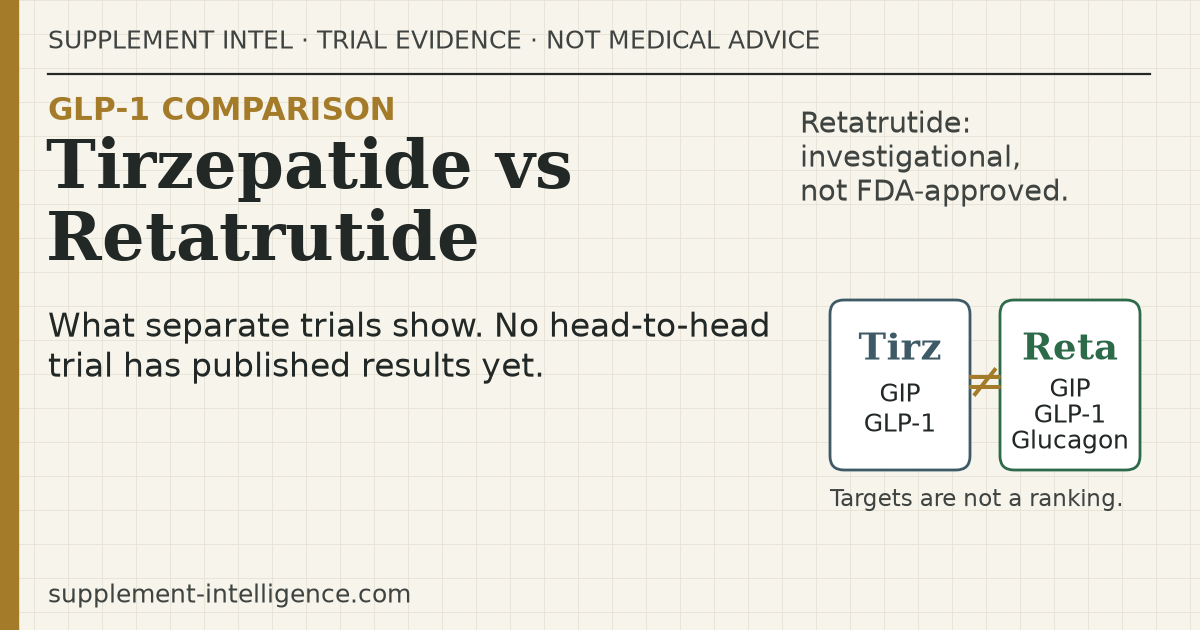
There is no published head-to-head trial of tirzepatide versus retatrutide as of November 15, 2026. The trial designed to compare them, TRIUMPH-5, has no posted results. Every number below comes from separate trials, each comparing one drug with placebo. [TRIUMPH-5 registry]
Evidence reviewed: November 15, 2026.
Retatrutide has larger reported mean weight reductions in some separate trials, but these results do not establish that it is better than tirzepatide. Grade C for the unmatched comparison. [SURMOUNT-1] [TRIUMPH-1]
Retatrutide is investigational and not FDA-approved; tirzepatide is FDA-approved as Zepbound and Mounjaro. [FDA] [Zepbound] [Mounjaro]
TL;DR
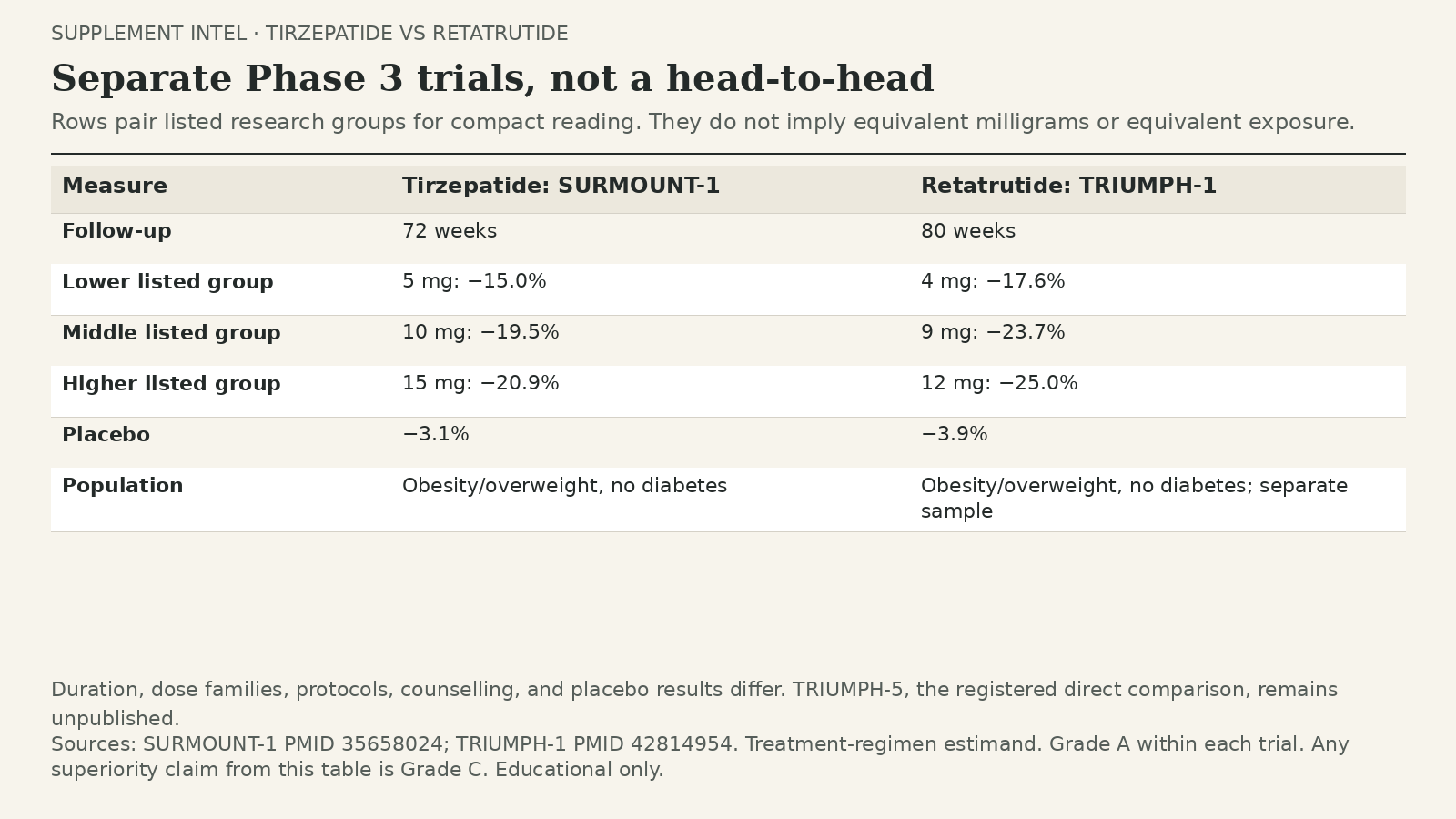
- Grade A: SURMOUNT-1 reported tirzepatide mean weight changes of −15.0%, −19.5%, and −20.9% at 72 weeks, versus −3.1% with placebo. [PMID 35658024]
- Grade A: TRIUMPH-1 reported retatrutide mean weight changes of −17.6%, −23.7%, and −25.0% at 80 weeks, versus −3.9% with placebo. [PMID 42814954]
- Grade A: the diabetes trials also reported weight reductions, but used different populations, durations, and dose groups. [SURMOUNT-2] [TRIUMPH-2]
- Grade C: TRIUMPH-5 is the direct comparison, with no posted results in the registry review dated November 10, 2026. [TRIUMPH-5 registry]
- Retatrutide is unapproved and cannot be compounded under federal law. [FDA]
Get one email a week grading 3–5 health claims A, B or C from the actual studies. Free, no hype. Subscribe →
Is retatrutide better than tirzepatide?
The available evidence cannot answer that directly: the published weight results come from separate placebo-controlled trials, while the trial comparing the drugs has no results. Grade C for a claim of superiority. [SURMOUNT-1] [TRIUMPH-1] [TRIUMPH-5 registry]
The distinction matters when reading the largest percentages: −25.0% belongs to a retatrutide group observed for 80 weeks, while −20.9% belongs to a tirzepatide group observed for 72 weeks. Grade A for weight loss versus placebo with each drug, because several randomized trials agree; each percentage belongs to its own trial. [SURMOUNT-1] [TRIUMPH-1]
Putting those figures beside each other does not create a randomized comparison between the drugs; participants were randomized within each study, not between SURMOUNT-1 and TRIUMPH-1. Grade C for that cross-trial interpretation. [SURMOUNT-1] [TRIUMPH-1]
What did the obesity trials show (SURMOUNT-1 vs TRIUMPH-1)?
SURMOUNT-1 enrolled 2,539 adults without diabetes who had obesity (BMI 30 or more) or overweight (BMI 27 or more) plus at least one weight-related health problem; TRIUMPH-1 randomized 2,339 adults with obesity without diabetes. Grade B (trial design details, each from one trial). [SURMOUNT-1] [TRIUMPH-1]
Both reported “treatment-regimen” weight results. In plain terms, that analysis counts everyone assigned to a group, including people who stopped taking the drug, so it is closer to real-world use than results only from people who kept taking it. Grade B (analysis methods, each from one trial). [SURMOUNT-1] [TRIUMPH-1]
| Trial | Drug: trial dose and mean weight change | Placebo | Time |
|---|---|---|---|
| SURMOUNT-1 [SURMOUNT-1] | Tirzepatide: 5 mg −15.0%; 10 mg −19.5%; 15 mg −20.9% | −3.1% | 72 weeks |
| TRIUMPH-1 [TRIUMPH-1] | Retatrutide: 4 mg −17.6%; 9 mg −23.7%; 12 mg −25.0% | −3.9% | 80 weeks |
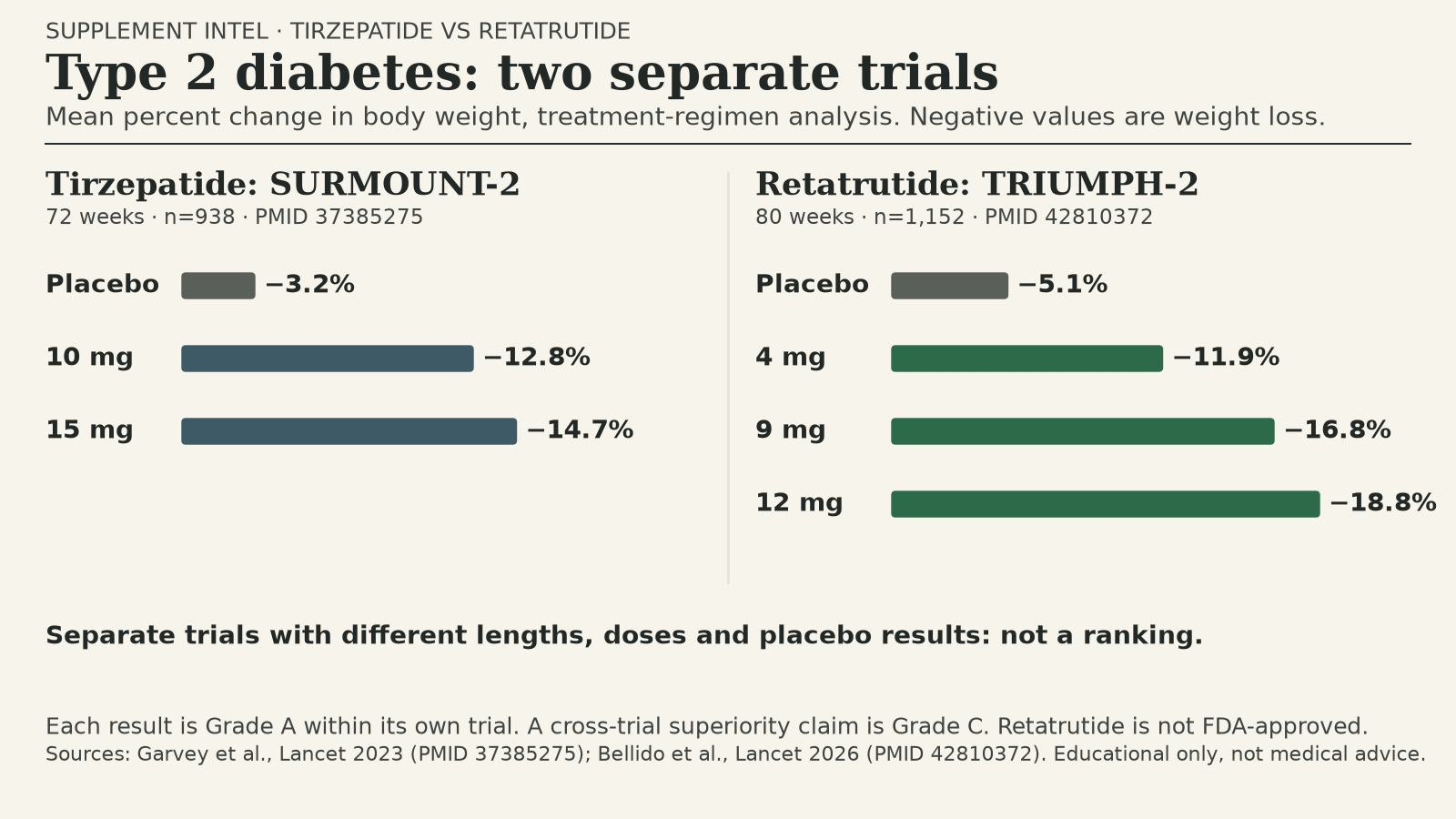
| SURMOUNT-2 [SURMOUNT-2] | Tirzepatide: 10 mg −12.8%; 15 mg −14.7% | −3.2% | 72 weeks |
| TRIUMPH-2 [TRIUMPH-2] | Retatrutide: 4 mg −11.9%; 9 mg −16.8%; 12 mg −18.8% | −5.1% | 80 weeks |
What trial-design differences matter?
The table keeps population, sample size, time, trial doses, placebo response, and analysis approach attached to the study that produced them; the shared treatment-regimen label does not erase those differences. Grade C for comparisons across studies. [SURMOUNT-1] [TRIUMPH-1] [SURMOUNT-2] [TRIUMPH-2]
| Trial | Population | n | Duration | Doses | Placebo weight change | Estimand |
|---|---|---|---|---|---|---|
| SURMOUNT-1 [SURMOUNT-1] | Obesity or overweight plus complication; no diabetes | 2,539 | 72 weeks | 5, 10, 15 mg | −3.1% | Treatment-regimen |
| TRIUMPH-1 [TRIUMPH-1] | Obesity; no diabetes | 2,339 | 80 weeks | 4, 9, 12 mg | −3.9% | Treatment-regimen |
| SURMOUNT-2 [SURMOUNT-2] | Obesity or overweight; type 2 diabetes | 938 | 72 weeks | 10, 15 mg | −3.2% | Treatment-regimen |
| TRIUMPH-2 [TRIUMPH-2] | Obesity or overweight; type 2 diabetes | 1,152 | 80 weeks | 4, 9, 12 mg | −5.1% | Treatment-regimen |
SURMOUNT-1 included a 20-week dose-escalation period within its 72 weeks; its endpoint is therefore not a measurement after 72 weeks entirely at the assigned maintenance dose. Grade B (a design detail from one trial). [PMID 35658024]
What about people with type 2 diabetes (SURMOUNT-2 vs TRIUMPH-2)?
SURMOUNT-2 reported mean weight changes of −12.8% and −14.7% with tirzepatide 10 and 15 mg, versus −3.2% with placebo at 72 weeks. Grade A. [PMID 37385275]
TRIUMPH-2 reported −11.9%, −16.8%, and −18.8% with retatrutide 4, 9, and 12 mg, versus −5.1% with placebo at 80 weeks. Grade A. [PMID 42810372]
The diabetes studies were not identical: SURMOUNT-2 enrolled adults with HbA1c of 7–10%, while TRIUMPH-2 used 6.5–10.5% and required stable diabetes treatment before screening. Grade B for these trial characteristics, each reported by one trial. [SURMOUNT-2] [TRIUMPH-2]
SURMOUNT-2 included outcomes regardless of treatment discontinuation or initiation of antihyperglycaemic rescue therapy; TRIUMPH-2 included all randomized participants in efficacy analyses and imputed missing data for its treatment-regimen analysis. Grade B (analysis methods, each from one trial). [SURMOUNT-2] [TRIUMPH-2]
How do side effects compare?
Gastrointestinal events were the most common adverse events in all these studies; the SURMOUNT reports described most as mild to moderate, and SURMOUNT-1 noted they occurred mainly during escalation. Grade A. [SURMOUNT-1] [TRIUMPH-1] [SURMOUNT-2] [TRIUMPH-2]
In SURMOUNT-1, adverse events caused discontinuation in 4.3%, 7.1%, and 6.2% of participants assigned tirzepatide 5, 10, and 15 mg, versus 2.6% with placebo. Grade B: these exact rates come from one trial. [PMID 35658024]
The TRIUMPH-1 abstract gives no gastrointestinal event percentages; a Lilly company release reports adverse-event discontinuation of 4.1%, 6.9%, and 11.3% at 4, 9, and 12 mg, versus 4.9% with placebo. Grade B for the company figures. [TRIUMPH-1] [Lilly release]
The same company release reports nausea in 28.6%, 38.4%, and 42.4%, versus 14.8% with placebo, and dysesthesia in 5.1%, 12.3%, and 12.5%, versus 0.9%. Grade B. [Lilly release]
In TRIUMPH-2, diarrhea occurred in 27%, 34%, and 34% across the retatrutide groups versus 13% with placebo; nausea occurred in 14%, 21%, and 28% versus 8%. Grade B: these exact rates come from one trial. [PMID 42810372]
TRIUMPH-2 also reported hypotension in 1%, 5%, and 6% versus less than 1%, and dysesthesia in 4%, 6%, and 7% versus 1%; permanent discontinuation due to adverse events or death was 4%, 12%, and 8% versus 5%. Grade B: these exact rates come from one trial. [PMID 42810372]
SURMOUNT-2 reported adverse-event discontinuation below 5%, but comparing that directly with the differently described TRIUMPH-2 discontinuation endpoint cannot establish which drug is better tolerated. Grade C for that comparison. [SURMOUNT-2] [TRIUMPH-2]
How do the drugs work differently?
Tirzepatide activates GIP and GLP-1 receptors; retatrutide is a single peptide that activates GIP, GLP-1, and glucagon receptors. Grade B for the retatrutide mechanism described in the Phase 2 report. [PMID 37366315] [SURMOUNT-1]
Glucagon-receptor activity contributed to increased energy expenditure in obese mice, but that animal finding cannot establish a human advantage over tirzepatide. Grade C for extrapolation to people. [PMID 35985340]
The early Phase 1b retatrutide study found an approximately 6-day half-life and pharmacokinetics supporting once-weekly study dosing; that finding is not a switching or dose-conversion study. Grade B. [PMID 36354040]
Can you switch from tirzepatide to retatrutide?
There are no published switching data in this evidence set, and TRIUMPH-5 has no results; a direct-comparison registration does not provide a switching plan. Grade C. [TRIUMPH-5 registry]
Retatrutide remains unapproved, and FDA states it cannot be compounded under federal law. [FDA]
This page is not a switching plan. Anyone considering a change in medicine can ask a licensed clinician about approved options. The trial dose groups above only identify which evidence is being described.
Retatrutide vs Zepbound or Mounjaro: what's the difference?
Zepbound and Mounjaro are both brand names for tirzepatide, which is FDA-approved. Zepbound is approved for weight management and for moderate-to-severe obstructive sleep apnea with obesity [Zepbound safety summary]. Mounjaro is approved to improve blood sugar in type 2 diabetes and to reduce major cardiovascular events in adults with type 2 diabetes at high risk [Mounjaro prescribing summary]. So “retatrutide vs Zepbound” and “retatrutide vs Mounjaro” are the same drug comparison as this page.
Retatrutide is a different investigational drug, not an approved version of either brand; its additional receptor target does not supply a head-to-head outcome. [FDA] [Lilly Medical Information] [TRIUMPH-5 registry]
When will TRIUMPH-5 report?
Lilly has not announced when TRIUMPH-5 results will come out; the November 10, 2026 registry review lists TRIUMPH-5, NCT06662383, as active, not recruiting, with no posted results and no milligram doses listed in its arms. Grade C. [TRIUMPH-5 registry]
Lilly Medical Information, last reviewed August 4, 2026, describes a planned BLA submission in the first quarter of 2027, with no guarantee; that company plan is not an approval or a TRIUMPH-5 reporting date. Grade B. [Lilly Medical Information]
Lilly released top-line results in July 2026 from TRIUMPH-3, a separate retatrutide trial in adults with severe obesity and established cardiovascular disease. These are company data, not yet published in a peer-reviewed journal, so this page does not use their figures. [Lilly July 2026 release, company source]
How should I read these grades?
- Grade A: consistent randomized human evidence for that exact outcome (more than one randomized trial agreeing, or a pooled analysis of consistent trials).
- Grade B: human evidence that is limited, mixed, short, small, from a single trial, or surrogate-only (for example, a lab or imaging measure instead of how people feel or function).
- Grade C: animal, lab, cell, mechanistic, uncontrolled, anecdotal or expert-opinion evidence, comparisons between separate trials, or no human evidence.
For example, weight loss versus placebo is Grade A for each drug because several randomized trials agree; exact side-effect rates from one trial are Grade B, even when that trial is a large Phase 3 trial; and the claim that the retatrutide percentages prove superiority is Grade C because it crosses unmatched trials. [SURMOUNT-1] [TRIUMPH-1]
Frequently asked questions
Is retatrutide better than tirzepatide?
No published head-to-head result establishes that retatrutide is better; comparisons between the separate weight trials are Grade C. [TRIUMPH-5 registry]
What was the highest-dose weight result without diabetes?
In SURMOUNT-1, people on tirzepatide 15 mg had a mean weight change of −20.9% at 72 weeks (placebo −3.1%). In a separate trial, TRIUMPH-1, people on retatrutide 12 mg had −25.0% at 80 weeks (placebo −3.9%). The two drugs were not tested against each other, so these numbers cannot show which works better. Weight loss versus placebo is Grade A for each drug, because several randomized trials agree. [PMID 35658024] [PMID 42814954]
What did the type 2 diabetes trials show?
SURMOUNT-2 reported −14.7% with tirzepatide 15 mg at 72 weeks, and TRIUMPH-2 reported −18.8% with retatrutide 12 mg at 80 weeks; weight loss versus placebo is Grade A for each drug because several randomized trials agree, but comparing these separate results is Grade C. [PMID 37385275] [PMID 42810372]
Do both drugs cause gastrointestinal side effects?
Gastrointestinal events were the most common adverse events in the published SURMOUNT-1 and TRIUMPH-1 reports. That finding is Grade A because randomized trials of both drugs agree. [PMID 35658024] [PMID 42814954]
Is there a published switching plan?
No published switching data are available in this evidence set, and retatrutide is unapproved. [TRIUMPH-5 registry] [FDA]
Does TRIUMPH-5 have a reporting date?
Lilly has not announced when TRIUMPH-5 results will come out; the registry review found no posted results, which is Grade C evidence about an unpublished trial. [TRIUMPH-5 registry]
Where can I read related evidence?
- BPC-157 side effects
- Retatrutide hub: what it does and side effects
- Retatrutide trial dosing schedules
- Tirzepatide side effects
- Tirzepatide vs semaglutide
- GLP-1 and muscle loss
- Oral GLP-1 evidence
- What happens after stopping tirzepatide
- TB-500 evidence review
Browse the GLP-1 evidence index and how we handle references.
Want the next one graded?
Every week we take a few claims you'll see online and check them against the research. Plain English, sources linked, not medical advice.
Get the free weekly emailWhat are the primary sources for this comparison?
- Jastreboff AM et al. Tirzepatide Once Weekly for the Treatment of Obesity (SURMOUNT-1). N Engl J Med. 2022;387(3):205–216. PMID 35658024
- Jastreboff AM et al. Retatrutide, a Triple Hormone Receptor Agonist, for Treatment of Obesity (TRIUMPH-1). N Engl J Med. 2026;395(18):1781–1793. PMID 42814954
- Garvey WT et al. Tirzepatide once weekly for the treatment of obesity in people with type 2 diabetes (SURMOUNT-2). Lancet. 2023;402(10402):613–626. PMID 37385275
- Bellido V et al. Retatrutide in adults with obesity and type 2 diabetes (TRIUMPH-2). Lancet. 2026;408(10563):1455–1472. PMID 42810372
- ClinicalTrials.gov. Registry status reviewed November 10, 2026. TRIUMPH-5, NCT06662383
- FDA. FDA’s concerns with unapproved GLP-1 drugs used for weight loss
- Lilly. May 21, 2026 company release; Grade B. TRIUMPH-1 company figures
- Lilly Medical Information. Last reviewed August 4, 2026; Grade B company statement. Is retatrutide available in the consumer market?
- Eli Lilly and Company. Zepbound Indications and Safety Summary, included in the May 21, 2026 TRIUMPH-1 release.
- Jastreboff AM et al. Triple-Hormone-Receptor Agonist Retatrutide for Obesity - A Phase 2 Trial. N Engl J Med. 2023;389(6):514–526. PMID 37366315
- Urva S et al. LY3437943, a novel triple GIP, GLP-1, and glucagon receptor agonist in people with type 2 diabetes: a phase 1b trial. Lancet. 2022;400(10366):1869–1881. PMID 36354040
- Coskun T et al. LY3437943, a novel triple glucagon, GIP, and GLP-1 receptor agonist for glycemic control and weight loss: from discovery to clinical proof of concept. Cell Metab. 2022;34(9):1234–1247. PMID 35985340
- Eli Lilly and Company. Mounjaro (tirzepatide) indication and safety summary. Fetched November 15, 2026.
- Eli Lilly and Company. Lilly’s triple agonist, retatrutide, successful in two additional Phase 3 obesity trials, delivering significant improvements in weight and A1C. July 23, 2026. Company source (press release announcing TRIUMPH-2 and TRIUMPH-3 top-line results), not peer reviewed. Fetched November 25, 2026.
This page summarizes published trials. It is not medical advice, a recommendation to start or stop a medicine, or an instruction to use retatrutide. Trial evidence is not a recommendation to use a product. Retatrutide is not FDA-approved. [FDA]