Home / GLP-1 / Retatrutide / Dosing schedule
Retatrutide dosing schedule: what the clinical trials used
Evidence reviewed: November 15, 2026.
Retatrutide is investigational, is not FDA-approved, and has not been found safe and effective for any condition. It cannot be compounded under federal law. There is no approved retatrutide dose. [FDA]
This page reports what clinical trials assigned. It is not a dosing guide and not medical advice.
TL;DR
- There is no approved retatrutide dosing schedule. Everything below describes research protocols run under medical supervision. [FDA]
- Trials gave retatrutide once weekly as an injection under the skin, at assigned doses from 0.5 mg to 12 mg. [PMIDs 36354040, 37366315, 41090431]
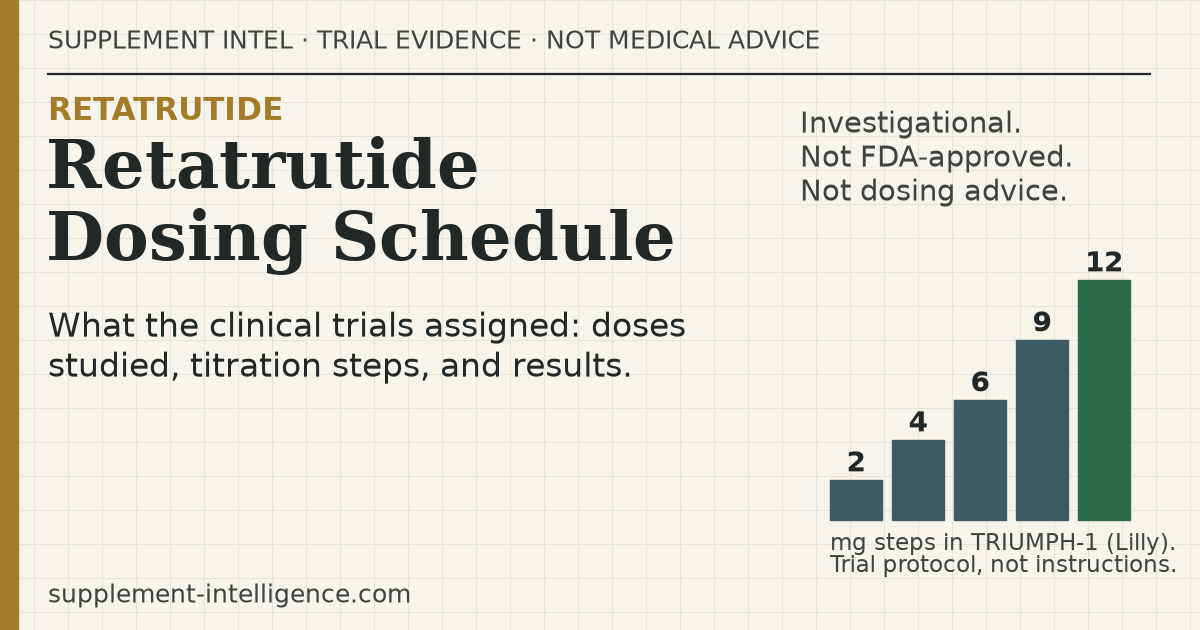
- In TRIUMPH-1, participants started at 2 mg and the dose rose every four weeks until it reached the assigned 4, 9 or 12 mg (company protocol description, Grade B). [Lilly TRIUMPH-1 release]
- In Phase 2, a lower starting dose partly reduced stomach and bowel side effects (Grade B). [PMID 37366315]
- In TRIUMPH-1, mean weight change at 80 weeks was −17.6%, −23.7% and −25.0% with 4, 9 and 12 mg versus −3.9% with placebo (weight loss versus placebo is Grade A, because several randomized trials agree). [PMID 42814954]
- Retatrutide's half-life was about 6 days in a small Phase 1b study (Grade B). [PMID 36354040]
Get one email a week grading 3–5 health claims A, B or C from the actual studies. Free, no hype. Subscribe →
What retatrutide doses did the clinical trials use?
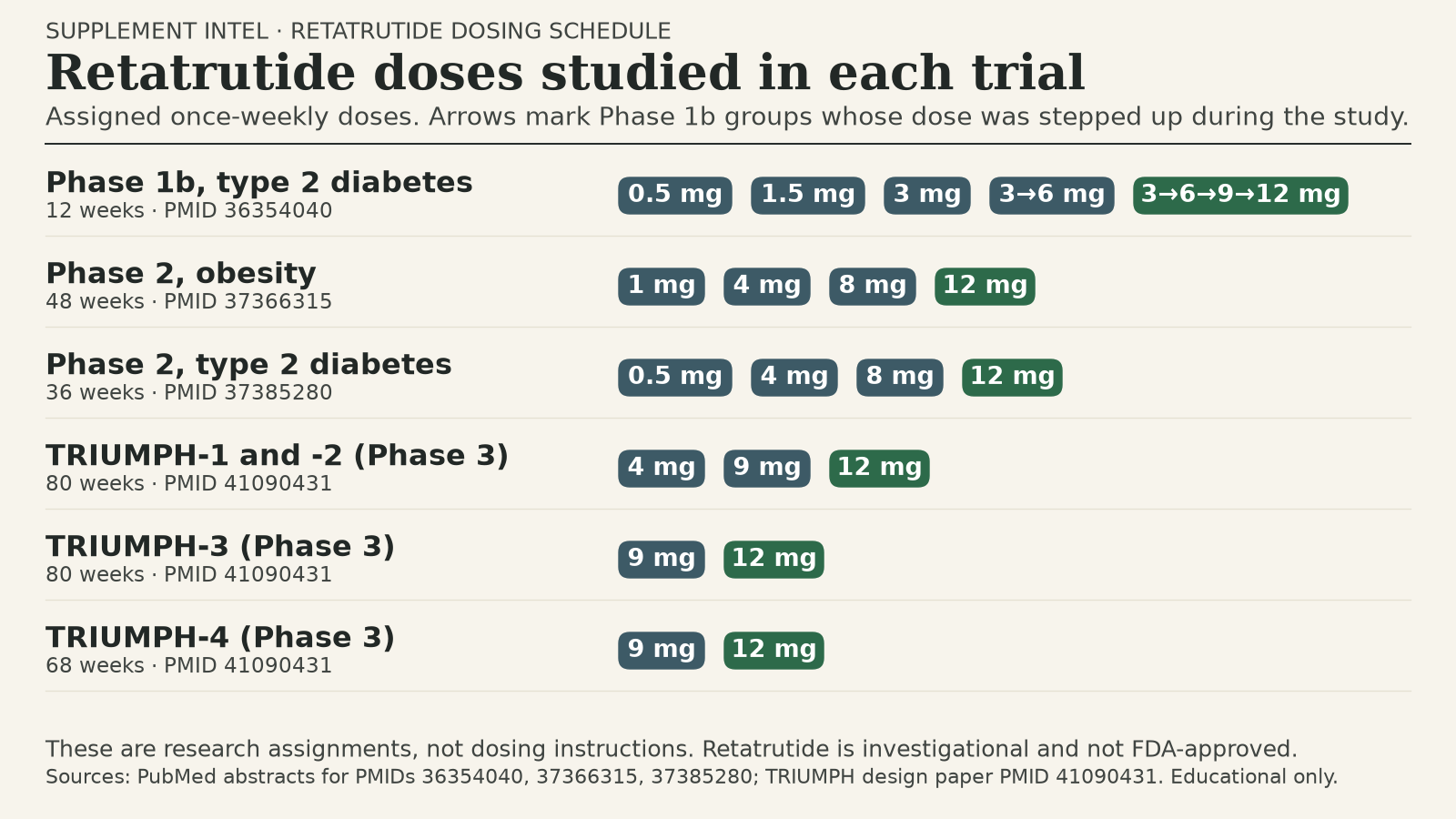
Every published retatrutide trial used a once-weekly injection under the skin. The doses below are what each trial assigned. They describe research groups, not steps for anyone to follow. More on what the drug does and its side effects is on our retatrutide evidence page.
| Trial | Who was studied | Assigned weekly doses | Length | Source |
|---|---|---|---|---|
| Phase 1b | 72 adults with type 2 diabetes | 0.5, 1.5 or 3 mg; 3 then 6 mg; 3 then 6, 9 and 12 mg (or dulaglutide 1.5 mg, or placebo) | 12 weeks | [PMID 36354040] |
| Phase 2 obesity | 338 adults with obesity, or overweight plus a weight-related condition | 1, 4, 8 or 12 mg (or placebo) | 48 weeks | [PMID 37366315] |
| Phase 2 type 2 diabetes | 281 adults with type 2 diabetes | 0.5, 4, 8 or 12 mg (or dulaglutide 1.5 mg, or placebo) | 36 weeks | [PMID 37385280] |
| TRIUMPH-1 and TRIUMPH-2 | Obesity or overweight, without and with type 2 diabetes | 4, 9 or 12 mg | 80 weeks | [PMID 41090431] |
| TRIUMPH-3 | Obesity with established cardiovascular disease | 9 or 12 mg | 80 weeks | [PMID 41090431] |
| TRIUMPH-4 | Painful knee osteoarthritis with obesity or overweight | 9 or 12 mg | 68 weeks | [PMID 41090431] |
What was the retatrutide titration schedule in TRIUMPH?
Titration means starting at a lower dose and raising it in steps. Lilly's TRIUMPH-1 announcement describes the Phase 3 schedule this way: participants started at 2 mg once weekly and the dose was increased every four weeks until it reached the assigned dose. That is Grade B evidence, because it is a company protocol description rather than a methods section we could read in the published paper. [Lilly TRIUMPH-1 release]
| Assigned dose in TRIUMPH-1 | Steps before reaching it | Week the assigned dose was reached* |
|---|---|---|
| 4 mg | 2 mg | Week 4 |
| 9 mg | 2 mg, then 4 mg, then 6 mg | Week 12 |
| 12 mg | 2 mg, then 4 mg, then 6 mg, then 9 mg | Week 16 |
*Calculated from the four-week step interval Lilly describes. [Lilly TRIUMPH-1 release]
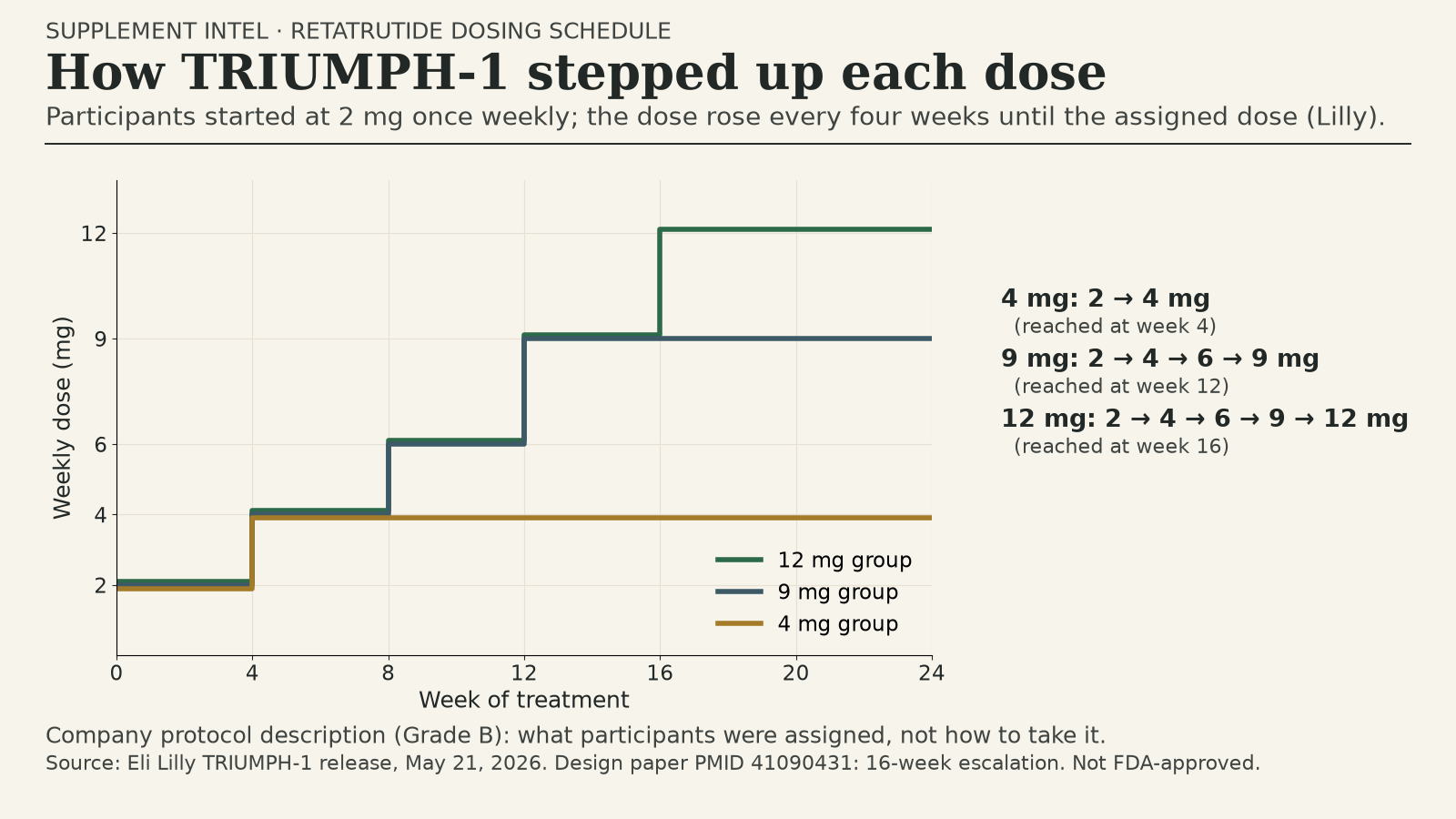
The peer-reviewed TRIUMPH design paper fits this picture. It describes a fixed, blinded escalation over 16 weeks in the 80-week trials, followed by 64 weeks at the maintenance dose. The protocols allowed a permanent dose reduction in specified situations, such as persistent stomach or bowel problems or not eating enough despite other measures. Participants also received healthy-diet and physical-activity counselling. The design paper is Grade B. [PMID 41090431]
Notice that the Phase 3 steps (2, 4, 6, 9, 12 mg) differ from the Phase 2 steps (2, 4, 8, 12 mg). A schedule copied from one trial does not describe the other.
How did the Phase 2 retatrutide trials escalate the dose?
The Phase 2 obesity trial assigned groups to 1 mg, 4 mg (starting at 2 mg or 4 mg), 8 mg (starting at 2 mg or 4 mg) or 12 mg (starting at 2 mg), or placebo, once weekly for 48 weeks. [PMID 37366315] The trial registry describes these paths:
| Assigned maintenance dose | Starting dose and sequence in the registry |
|---|---|
| 1 mg | 1 mg; no escalation described |
| 4 mg | 2 mg then 4 mg, or 4 mg from the start |
| 8 mg | 2, 4, then 8 mg; or 4 then 8 mg |
| 12 mg | 2, 4, 8, then 12 mg |
Some groups increased their dose up to week 12. Grade B. [NCT04881760]
The Phase 2 type 2 diabetes trial used maintenance doses of 0.5 mg, 4 mg (starting at 2 mg, or no escalation), 8 mg (starting at 2 mg or at 4 mg) and 12 mg (starting at 2 mg), compared with placebo and dulaglutide 1.5 mg. Grade B. [PMID 37385280]
What did the Phase 1b retatrutide study test?
The first multiple-dose study enrolled 72 adults with type 2 diabetes for 12 weeks. Retatrutide groups received 0.5 mg, 1.5 mg, 3 mg, 3 then 6 mg, or 3 then 6, 9 and 12 mg, with the top doses reached by stepwise increases. Adverse events (any health problem during the study, whether or not the drug caused it) were reported by 63% of people on retatrutide and 54% on placebo. Stomach and bowel problems were the most common. Grade B: a small, short study. [PMID 36354040]
What is the half-life of retatrutide?
In the Phase 1b study, retatrutide's half-life was approximately 6 days, and its blood levels rose in proportion to dose. The authors said this supports once-weekly dosing, which is how every later trial gave it. Grade B. [PMID 36354040] A long half-life explains the weekly schedule in trials. It does not tell anyone how to time doses outside a trial.
Did the starting dose change retatrutide side effects?
In the Phase 2 obesity trial, stomach and bowel side effects were dose-related, mostly mild to moderate, and partially mitigated with a lower starting dose (2 mg vs 4 mg). Grade B. [PMID 37366315]
The registry's posted results show the size of that difference in the 8 mg groups: nausea in 6 of 35 people (17.1%) who started at 2 mg versus 21 of 35 (60.0%) who started at 4 mg, counted through safety follow-up of up to 52 weeks. These are small groups. Grade B. [NCT04881760]
In the Phase 2 diabetes trial, mild-to-moderate gastrointestinal events ranged from 13% in the 0.5 mg group to 50% (12 of 24) in the 8 mg group that started at 4 mg. The placebo group also had 13%. [PMID 37385280] A full rundown of reported side effects is in retatrutide side effects.
What weight results go with each retatrutide dose?
These results belong to specific trials and timepoints. They are averages for groups, not predictions for a person.
| Assigned dose | TRIUMPH-1, 80 weeks (no diabetes) | TRIUMPH-2, 80 weeks (type 2 diabetes) | Phase 2 obesity, 48 weeks |
|---|---|---|---|
| Placebo | −3.9% | −5.1% | −2.1% |
| 1 mg | not studied | not studied | −8.7% |
| 4 mg | −17.6% | −11.9% | −17.1% (combined) |
| 8 mg | not studied | not studied | −22.8% (combined) |
| 9 mg | −23.7% | −16.8% | not studied |
| 12 mg | −25.0% | −18.8% | −24.2% |
TRIUMPH-1 (2,339 participants) and TRIUMPH-2 (1,152 participants) figures use the treatment-regimen analysis, which counts everyone assigned to a group whether or not they kept taking the drug. Weight loss versus placebo is Grade A, because these trials and the Phase 2 trials agree. [PMIDs 42814954, 42810372] The Phase 2 figures are least-squares means; “combined” pools the two starting-dose groups. Grade B. [PMID 37366315]
Lilly's announcement also reports higher “efficacy estimand” figures for TRIUMPH-1, which estimate results had everyone stayed on treatment. Those are a different analysis and should not be mixed with the figures above. [Lilly TRIUMPH-1 release]
How much retatrutide should I take?
No personal retatrutide dose has been established, and none of the sources on this page supply one. Retatrutide is not approved, the FDA says it has not been found safe and effective for any condition, and it cannot be compounded under federal law. [FDA] The FDA has also warned companies that illegally sold unapproved drugs containing retatrutide that were falsely labeled “for research purposes” or “not for human consumption.” Those products do not carry the trials' evidence or quality controls. [FDA]
Lilly says retatrutide has not been approved by the FDA or any other regulator and plans to submit an application in the first quarter of 2027, with no guarantee of approval. That is a company statement (Grade B). [Lilly Medical Information] Anyone weighing a weight-loss medicine can ask a licensed clinician about approved options.
How should I read the evidence grades on this page?
- Grade A: consistent randomized human evidence for that exact outcome (more than one randomized trial agreeing, or a pooled analysis of consistent trials).
- Grade B: human evidence that is limited, mixed, short, small, from a single trial, or surrogate-only (for example, a lab or imaging measure instead of how people feel or function).
- Grade C: animal, lab, cell, mechanistic, uncontrolled, anecdotal or expert-opinion evidence, comparisons between separate trials, or no human evidence.
Frequently asked questions
What is the retatrutide dosing schedule?
There is no approved retatrutide dosing schedule. Retatrutide is investigational and not FDA-approved. In trials it was given as a once-weekly injection under the skin at assigned doses from 0.5 mg to 12 mg. These are research protocols, not instructions for use. [PMIDs 36354040, 37366315, 37385280, 41090431]
What was the retatrutide titration schedule in TRIUMPH-1?
Lilly says TRIUMPH-1 participants started at 2 mg once weekly and the dose was increased every four weeks until the assigned dose: 4 mg via one step at 2 mg, 9 mg via steps at 2, 4 and 6 mg, and 12 mg via steps at 2, 4, 6 and 9 mg. This is a company protocol description (Grade B), not a dosing guide. [Lilly TRIUMPH-1 release]
What doses of retatrutide were studied?
Phase 1b studied 0.5, 1.5, 3, 3 then 6, and 3 then 6, 9 and 12 mg. Phase 2 studied 1, 4, 8 and 12 mg in obesity and 0.5, 4, 8 and 12 mg in type 2 diabetes. TRIUMPH-1 and TRIUMPH-2 studied 4, 9 and 12 mg; TRIUMPH-3 and TRIUMPH-4 studied 9 and 12 mg. [PMIDs 36354040, 37366315, 37385280, 41090431]
How much retatrutide should I take?
No personal dose has been established. Retatrutide is not approved, and the FDA says it has not been found safe and effective for any condition and cannot be compounded under federal law. Trial doses were given under medical supervision and are not instructions. [FDA]
What is the half-life of retatrutide?
In a 12-week Phase 1b study in people with type 2 diabetes, retatrutide's half-life was approximately 6 days, and the authors said its pharmacokinetics suggest suitability for once-weekly dosing. That is Grade B evidence from a small early trial. [PMID 36354040]
Did a lower starting dose reduce side effects?
In the Phase 2 obesity trial, gastrointestinal side effects were dose-related, mostly mild to moderate, and partially mitigated with a lower starting dose (2 mg vs 4 mg). That is Grade B evidence from one Phase 2 trial. [PMID 37366315]
Related retatrutide and GLP-1 guides
- Retatrutide: what it does, side effects, and trial results
- Tirzepatide vs retatrutide: what separate trials show
- Tirzepatide side effects: what trials and labels show
- Does GLP-1 use cause muscle loss?
- Oral GLP-1 pills: what the trials show
- BPC-157 side effects: what human studies show
- GLP-1 vitamins and supplements: what has evidence
- Other peptides graded by evidence
Want the next one graded?
Every week we take a few claims you'll see online and check them against the research. Plain English, sources linked, not medical advice.
Get the free weekly emailWhat are the primary sources for this retatrutide dosing review?
- Urva S et al. LY3437943, a novel triple GIP, GLP-1, and glucagon receptor agonist in people with type 2 diabetes: a phase 1b, multicentre, double-blind, placebo-controlled, randomised, multiple-ascending dose trial. Lancet. 2022;400(10366):1869–1881. PMID 36354040. DOI: 10.1016/S0140-6736(22)02033-5.
- Jastreboff AM et al. Triple-Hormone-Receptor Agonist Retatrutide for Obesity - A Phase 2 Trial. N Engl J Med. 2023;389(6):514–526. PMID 37366315. DOI: 10.1056/NEJMoa2301972.
- Rosenstock J et al. Retatrutide, a GIP, GLP-1 and glucagon receptor agonist, for people with type 2 diabetes: a randomised, double-blind, placebo and active-controlled, parallel-group, phase 2 trial conducted in the USA. Lancet. 2023;402(10401):529–544. PMID 37385280. DOI: 10.1016/S0140-6736(23)01053-X.
- Giblin K et al. Retatrutide for the treatment of obesity, obstructive sleep apnea and knee osteoarthritis: Rationale and design of the TRIUMPH registrational clinical trials. Diabetes Obes Metab. 2026;28(1):83–93. PMID 41090431. DOI: 10.1111/dom.70209.
- Jastreboff AM et al. Retatrutide, a Triple Hormone Receptor Agonist, for Treatment of Obesity (TRIUMPH-1). N Engl J Med. 2026;395(18):1781–1793. PMID 42814954. DOI: 10.1056/NEJMoa2604169.
- Bellido V et al. Retatrutide in adults with obesity and type 2 diabetes (TRIUMPH-2). Lancet. 2026;408(10563):1455–1472. PMID 42810372. DOI: 10.1016/S0140-6736(26)01861-1.
- ClinicalTrials.gov. NCT04881760: Phase 2 obesity arm descriptions and posted results. Reviewed November 10, 2026.
- Eli Lilly and Company. Lilly's triple agonist, retatrutide, delivered powerful weight loss in pivotal Phase 3 obesity trial. May 21, 2026. Company statement, Grade B. Fetched November 15, 2026.
- Lilly Medical Information. Is retatrutide available in the consumer market? Last reviewed August 4, 2026. Company statement, not an approval.
- FDA. FDA's Concerns with Unapproved GLP-1 Drugs Used for Weight Loss.
This page summarizes published trials and trial protocols. It is not medical advice, a dosing guide, or a recommendation to start, stop or change any medicine. Retatrutide is not FDA-approved.